Sunday, April 30, 2006
Smithsonian Global Sound
By David Font-Navarrete
Every lover of roots music with an internet connection should visit Smithsonian Folkways and Smithsonian Global Sound. You can browse an enormous, one-of-a-kind collection of essential music and information from around the world, download individual tracks in high-quality MP3 format and archival-quality FLAC format ... all without "security" algorithms that prevent you from transferring or sharing your purchases. From the Global Sound website:
"Smithsonian Global Sound delivers the world's diverse cultural expressions via the Internet in an informative way for a reasonable price. It also helps encourage local musicians and traditions around the planet through international recognition, the payment of royalties, and support for regional archives ... Launched in February 2005, SGS initially offers almost the entire Folkways and Smithsonian Folkways Recordings collections and the holdings of two regional archives: the International Library of African Music (ILAM), in Grahamstown, South Africa, and the Archives and Research Center for Ethnomusicology (ARCE), in New Delhi, India."
Some personal favorites from the Global Sound catalog:
Conga de Los Hoyos de Santiago de Cuba: "Conga de Santiago" on "Carnaval in Cuba" (FW04065): A tour through the mighty carnival music of my mother's hometown, complete with corneta china (double reed flute) and one of the most ass-shaking grooves known to humanity.
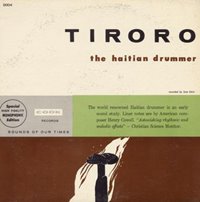
Tiroro: "Best Drummer in Haiti" on "Tiroro (Haitian Drums)" (COOK05004): A legend of Haitian drumming and singing solo. This is not hi-fi recording, but it is absolutely one of the most powerful percussion displays I've ever heard. Unbelieveable.
Bata ensemble of Sakete, Benin: "The Bata Repertoire for Shango in Sakete: Omenega" on "The World's Musical Traditions, Vol. 8: Yoruba Drums from Benin, West Africa" (SFW40440): Yoruba traditional music is an essential ingredient in Afrobeat, and the Bata drums are the supreme musical symbol of Yoruba tradition. Listen to this smoldering hot rhythm for the Yoruba deity of thunder and dance. Kaabiyesi o!
Also, check out Radio Global Sound and Radio Africa. Hours of gourgeous, rare music, streaming for FREE. Enjoy!
Every lover of roots music with an internet connection should visit Smithsonian Folkways and Smithsonian Global Sound. You can browse an enormous, one-of-a-kind collection of essential music and information from around the world, download individual tracks in high-quality MP3 format and archival-quality FLAC format ... all without "security" algorithms that prevent you from transferring or sharing your purchases. From the Global Sound website:
"Smithsonian Global Sound delivers the world's diverse cultural expressions via the Internet in an informative way for a reasonable price. It also helps encourage local musicians and traditions around the planet through international recognition, the payment of royalties, and support for regional archives ... Launched in February 2005, SGS initially offers almost the entire Folkways and Smithsonian Folkways Recordings collections and the holdings of two regional archives: the International Library of African Music (ILAM), in Grahamstown, South Africa, and the Archives and Research Center for Ethnomusicology (ARCE), in New Delhi, India."Some personal favorites from the Global Sound catalog:
Conga de Los Hoyos de Santiago de Cuba: "Conga de Santiago" on "Carnaval in Cuba" (FW04065): A tour through the mighty carnival music of my mother's hometown, complete with corneta china (double reed flute) and one of the most ass-shaking grooves known to humanity.
Tiroro: "Best Drummer in Haiti" on "Tiroro (Haitian Drums)" (COOK05004): A legend of Haitian drumming and singing solo. This is not hi-fi recording, but it is absolutely one of the most powerful percussion displays I've ever heard. Unbelieveable.
Bata ensemble of Sakete, Benin: "The Bata Repertoire for Shango in Sakete: Omenega" on "The World's Musical Traditions, Vol. 8: Yoruba Drums from Benin, West Africa" (SFW40440): Yoruba traditional music is an essential ingredient in Afrobeat, and the Bata drums are the supreme musical symbol of Yoruba tradition. Listen to this smoldering hot rhythm for the Yoruba deity of thunder and dance. Kaabiyesi o!
Also, check out Radio Global Sound and Radio Africa. Hours of gourgeous, rare music, streaming for FREE. Enjoy!
Host: David Font-Navarrete
David is part of a new generation of musicians, versatile and equally at home in traditional and modern music. He has performed professionally for more than a decade throughout the United States, as well as in Cuba, Canada, Europe, and Japan. David plays percussion with Chopteeth Afrofunk Big Band and Fertile Ground. He also works as a ritual drummer and singer in the Afro-Cuban Lukumi tradition. His own experimental project, Io, fuses ambient and electronic music with acoustic music to create futuristic soundscapes (available through CDBaby.com and iTunes). David runs the independent label Elegua Records. These days, he is also working toward an advanced degree in Ethnomusicology at the University of Maryland and exploring the universe of digital mixing, sampling, editing, effecting, and mutating sound as DJ Thick.
Saturday, April 29, 2006
Xalam Working On New Recording
By Robert FoxMatt Yanchyshyn of the outstanding African music blog Benn loxo du taccu has an nice post this month about the Senegalese group Xalam:
Xalam are a Senegalese band who originally formed in Dakar in 1969 before moving to Europe in the mid-70s. Their tight funk-rock-traditional fusion sound brought them great success abroad. They toured for 15 years all over Africa, Europe and North Africa, playing with the likes of Dizzy Gillespie, Crosby, Stills, And Nash, and The Rolling Stones along the way. The original group disbanded in 1989 when their founding member, Prosper Niang, passed away.Matt points out that the surviving Xalam members are reunited and are working on a new album. Xalam was influential in helping create the urban Senegalese sound with a creative mix of funk, jazz and traditional approaches.
While their recordings are difficult to find in the US (their album Apartheid is currently going for $59 used on Amazon.com), you can download and listen to samples of Xalam's music on their website. The Xalam website explains the name of the band:
Xalam, also called khalam, is a traditional stringed instrument from West Africa. Inspired by this, the afro-jazz percussive group from Senegal gave themselves the same name.I'm looking forward to hearing the new recording when it is available.
Friday, April 28, 2006
Lee "Scratch" Perry Returns to Jamaica
By Robert FoxMad reggae genius Lee "Scratch" Perry returns to Jamaica tomorrow for his first concert in his native country in more than 30 years.
He'll be headlining the Western Consciousness reggae festival in Westmoreland, Jamaica, outside of Negril. The event has been transformed into an informal tribute to Lee Perry, and includes Judy Mowatt, John Holt, Barrington Levy and other reggae greats.
The Jamaica Observer interviewed the legendary producer and composer last year when the historic concert was announced. Perry offered up that the reason he hadn't returned to perform in Jamaica from his home is Switzerland is because he was too busy "doing his job," which he defined as "fighting against Evil Forces."
Perry virtually invented reggae and dub in the late 1960s, and produced a long list of groundbreaking sonic statements by The Wailers and many other crucial Jamaican artists. He spent much of the subsequent decades locked in a personal spiritual quest that included burning down his own studio in a formal ceremony, then purportedly wandering homeless through Europe for extended periods. His return to active touring is a welcome blessing for fans worldwide (although a recent US tour was apparently canceled due to visa difficulties--crazy baldheads!).
The BBC website has a nice overview of Lee Perry's career, including some song files and a quote that says it all: "it was only four tracks on the machine, but I was picking up twenty from the extra-terrestrial squad." Other Scratch career highlights from the BBC:
* Alter egos include The Upsetter, Scratch, Pipecock Jackxon, Super Ape and Small Axe (real name - Rainford Hugh Perry)
* Cut his first record in 1959
* Threatened to kill Bob Marley after Bob nicked his backing band (they made it up though)
* Put a curse on the BBC that can never be undone till Perry's records are played round the clock
Be sure to check out the article "Good Always Conquers Evil: The Musical Genius of Lee Perry," for the influence of comic books, cartoons and kung-fu movies on Lee Perry's music.
Thursday, April 27, 2006
¡Azucar! Fania All-Stars Live in Africa Video
By Robert FoxI hope you have room to dance in front of your computer: get a load of this blistering streaming video clip of the Fania All-Stars from their historic 1974 concert in Kinshasa, Zaire (Congo), featuring Celia Cruz at the height of her powers, backed by one of the greatest big bands ever put together. Wow--now that's funky!
This footage is from the video "Fania All-Stars Live in Africa," shot in front of 80,000 people at Stadu du Hai in Kinshasa as part of the "Rumble in the Jungle" concert series linked to the Ali-Foreman fight (as depicted in "When We Were Kings"). The Fania Live in Africa video is now available on DVD.
Can I get a witness? This band defines classic salsa with its incredible, heart-stopping funk and masterful musicianship.
The Fania All-Stars of this era included salsero giants Hector Lavoe, Ray Barretto, Cheo Feliciano, Mongo Santamaria, Johnny Pacheco and many other world-class performers, musicians and dancers. Their epic 1975 "Live at Yankee Stadium" is arguably the greatest live salsa album ever recorded, especially considering the time and place. Volume 2 has a special spot on my playlist, and also includes historic live cuts from Roberto Clemente Coliseum in San Juan. Check it out for the sheer energy, gigantic groove and incomparable vibe. ¡Vaya!
Wednesday, April 26, 2006
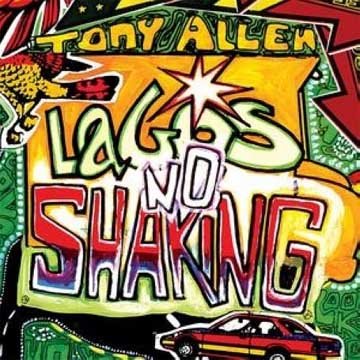
Tony Allen's "Lagos No Shaking"

By David McDavitt
Tony Allen returns with a much anticipated new project for his thirteenth release. Recorded live in Lagos, with a full-sized Afrobeat band, "Lagos No Shaking" (Lagos is OK), signifies Allen's return to roots Afrobeat after forays into avant-garde electronica hybrids. "Lagos No Shaking" is due to be released on June 13, 2006.
From the BBC:
"This set was recorded in Lagos, and manages to harness the rugged grit of that difficult city, whilst simultaneously presenting Allen's signature sound with a slick production sheen. Intense horn riffs, choppy guitar, call-and-response vocals: all of these elements are interwoven with Allen's detailed, cyclic beats, his taut tripping lending an elastic tension to the dancefloor.
The tunes tend to insinuate themselves after several airings. Young, soulful Yinka Davies powers abrasively through "Morose" and "Losun", two songs that boast almost annoyingly catchy choruses, then elderly groaner Fatai Rolling Dollar imparts a completely traditional juju feel to "Awa Na Re", prompting Allen to layer up some heavy hardcore percussion patterns."
From Amazon.com (with audio samples):
"Many people have attempted to reinvent Afrobeat - chief among them Fela's sons Femi and Seun - but Allen's take on the genre is streets ahead of either of them. Recorded in the Nigerian city over 10 hot, heavy nights, Lagos No Shaking presents a calmer, less manic Afrobeat, delicately balanced between laid-back insouciance and urgency, loose-limbed polyrhythms and ferocious grooves. Features 11 total tracks. Honest Jon's. 2006."
Yeah baby, insouciance!
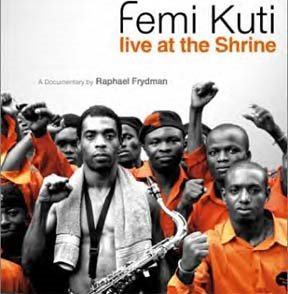
Femi's DVD Masterpiece

By David McDavitt
Femi Kuti hails "Live at the Shrine" DVD (includes live CD) to be his most cherished project because it reflects the reality of his music, his life, and of the Nigerian people.
"Live at the Shrine" contains a blistering live set interspersed with documentary footage of the New Africa Shrine (a nightclub, daytime hang-out, Femi's house, and spiritual & political center). Via the documentary we visit backstage with Femi's band & entourage, Lagos street life, and even Femi's inner sanctum (his on-site living quarters). We hear from Femi's sister (Yeni) and aunt (Fela's sister Dolupo), and see Femi interacting playfully with his wife & sons. Like his father, Femi has created a community around his venue- and his disciples idolize him as a prophet & guardian- it is quite heartening to witness.
This concert (87 min feature/46 min bonus) & interspersed documentary was filmed in Lagos during three shows on Femi's weekly "Sunday Jumps". All songs are strong, and all were chosen for performance/inclusion by his audience via democratic vote! Most songs are recorded uninterrupted and in their entirety. The quality of the video & sound is impeccable, though audio choices are limited to PCM 2.0 or AC3 2.0 only. It is equally amazing that such quality was achieved on a remote recording, and that the footage made it out of Nigeria (especially considering many of the songs denounce the abuses of the corrupt government). The band's sound is clear & well-balanced (amazing considering they are 20 strong!). Raphaël Frydman's cinematic sensibilities are quite pleasing, sensitive, and well edited. Frydman often employs split screen (like Woodstock) to great effect. DVD has optional subtitles in English, French, and Spanish (helpful in understanding Nigerian pidgin). The navigation screens are clear, attractive and efficient. Bonus footage includes more Femi interviews, a video for Shotan, and live uninterrupted footage of Yeparipa & Water no get Enemy.
OluFemi has matured greatly in the three years since his last offering. The music on this DVD (same on the "Africa Shrine" CD) is simply stunning- his best writing & performance to date. "Live at the Shrine" demonstrates Femi's return to pure, rootsy, powerful Fela-esque Afrobeat (i.e. less funk, no rap, and more serious political songs). This is unwesternized music for the hometown crowd! The songs have a groovy lope- absent is Femi's old tendency to rush his songs live. His 20+ member band is top-notch, infusing this recording with their own unique facets (ex. his jazz-influenced guitarist adds a lovely dimension).
Songs include: Dem Bobo , Oyimbo , I Wanna be Free , If Dem Want to Hear, Eho , "1, 2, 3, 4", Yeparipa , Can't Buy Me , Bring Me the Man Now , '97 , Shotan , and Water no Get Enemy.
"Live at the Shrine" is a masterpiece! Purcahse it here.
Tuesday, April 25, 2006
Afrobeat Band & Song Organization

By David McDavitt
Afrobeat Instrumentation (15-30 pieces)
o Sticks (claves)
o Drum set
o Bass Guitar (1+)
o Shekere
o Rhythm Congas (separate players for 2+ parts)
o Lead congas (3 akuba played by 1 player) and bells
o Rhythm Guitars (2+)
o Tenor Guitar (plays a finger-picked ostinato)
o Saxes (2+): bari. & tenor always, alto/sopr. occas.
o Trumpets (2+)
o Trombone (occas.)
o Organ/Keyboards (1 solo & 1 rhythm)
o Lead vocals
o Chorus vocals (6+)
Song form (early 70’s Afrobeat):
o Intro-chirping piano or guitar ostinato with percussion
. . . . . . . . . . . . . . . . . . lead conga, sticks, shekere)
o Rhythm guitar enters
o Bass guitar, drum kit, & rhythm congas enter
o Leader (Fela) solos on organ or sax
o Head (main theme) is introduced (horns)
o Series of horn solos [horn theme background]
o Head (main theme)
o Leader solos [horn theme background] Lyrics
o Lyrics with chorus response
o Lyrics/chorus/horn call & responses (increasingly interlocked & percussive)
o Leader Solo (Fela), end of song
Monday, April 24, 2006
Improvisation in African Music

By David McDavitt
A Buddhist monk, when queried about Zen music replied, “Fool, do you not even understand your own question?” I could empathsize with this undoubtedly bemused interviewer, while reading the surprising responses to Banning Erye’s interview regarding the concept of “improvisation” in African music with Abraham Adzenyah, (Wesleyan University, Akan master drummer), Kwaku Kwaakye Obeng (Akan traditional & jazz percussionist), & Eric Charry (author of "Mande Music"). Note the varied understandings of the word, “improvisation”.
(Excerpted from Afropop.org)
***********
Abraham Adzenyah (Akan-Ashanti)
AA: “...People should understand that these societies…are very conscious about their music… Without the music, there is no culture. Therefore, they don't want anybody to… make [it] your own. You add something to whatever rhythm you are playing. No. They would not allow that. They would throw you out.
But what happens is that we borrow rhythms within the same state…and that changes the feeling, a little bit… It is the same musical type, recreational musical. … Yes, you can do that... It's something that is within the system. It's just like a dictionary…
Banning: What about situation where it's recreational music, and the lead drummer is directing the dance? …. Is that improvising?
A.A.: No. He just changes the sequence; it's not an improvisation…. The lead drummer doesn't have as much freedom as people may think. Sometimes, he engages the supporting drummers in a dialogue… call and response…. If he played anything, it could be a proverb… or congratulating the singer, or asking for a drink from the person who is presiding over that occasion. That happens. You can call that an improvisation.
Banning: What would you call improvising in the traditional setting?
A.A.: In the Akan area, … when a woman gives birth to twins… you will see [women] getting together and playing an old hoe blade, and celebrating... That's spontaneous. And that is improvisation…
***********
Kwaku Kwaakye Obeng (Akan-Ashanti)
…
KKO: …When the chief or the king hasn't arrived yet, the kids can all play around and joke around. When the king and the chief show up, everybody is in order. When the chief for the king leaves, the floor is open. I'm sure that's when improvisation happened. It could be at the marketplace too… If you look at it that way, I think improvisation is everywhere.
In Africa, yes, drummers play for dancers, but when a dancer is coming onto the stage, you can play something ... just to prep that dancer … [When the dancer] is leaving the platform, the circle… That's when the drummer can practice their own style, add their own little licks in…
Banning: …A lot of the tradition that has been passed down through the ages creeps into jazz through all these different contexts…
Look at the clavé rhythm. Everybody knows about the clavé [in Cuban music]. But if you put the clave on guitar, like Bo Diddley did, you create a new world. That has led to a whole new genre in rock-and-roll today. It was played on wood, but put that on guitar and it's the same rhythm, but we're using it in a different context. I think that's improvisation…
***********
Eric Charry (Mande Music)
EC: [Improvisation is] crucial. It's built into the music. When a kora player or balafon player is playing, every piece of music has built-in variations. Some are personal, and some are passed down… It's expected that musicians will exercise these variations… A musician may just be recombining music of previous musicians, or there may be recombining in innovative ways, or they could be rejecting that and moving on to new styles…
Banning: I was always impressed with the way Malian guitarist Djelimady Tounkara could analyze what he was playing, saying what guitarist or kora player was responsible for this riff or vamp as opposed to that one…. But I guess his fluency in discussing the music that way was unusual, wasn't it?
E.C.: I agree. It's not often that a [Mande] musician would articulate to someone else where these various influences come from. Part of it is just secrecy, trying to guard your personal style, and not wanting others to grab onto it. I think you may find this with musicians all around the world. It's in their interest to build up a degree of mystique around their personal style. …
Banning: Why is improvising so prominent in Mande music, as compared with other African genres?
E.C… This goes back to their social system and their history. There is a class of musicians … known as jelis or griots. And their job, and their role in life, is to be the oral historians, musicians, and singers. So when you have a class that is patronized as such, and they spend all their time doing it, then they are apt to build a fairly sophisticated system…
In Mande music, there are more constraints that would prevent [jazz-like style evolutions] from happening… For example, with the kora, you were constrained by the tuning system. The 21 strings are tuned to different scales… One of the things that you will not find in African music is the kind of avant-garde movements… rebelling against bourgeois values …Those kinds of things don't make sense in Africa....They have a great respect for the past, and rejecting it is not part of their aesthetic.
To view the full interview, click here.
Sunday, April 23, 2006
Afrobeat Architect Tony Allen
By David McDavittAs eloquently stated on NaijaJams.com:
“One man is typically credited for the… African music into a form known as Afrobeat- Fela Anikulapo Kuti… But Fela cannot be single-handedly credited with its creation. An integral part of the equation was self-taught drummer Tony Allen who brought us those unmistakable rhythms that Afrobeat is known for today… Fela once reportedly claimed that without Tony Allen, there would be no Afrobeat. A strong statement, but it only demonstrates what an integral part Tony Allen was in the creation of the sound.”
For the complete article Click Here.
Tony Oladipo Allen was a cofounder of Afrobeat, as Fela’s drummer and longtime musical director. After a career in jazz and highlife Allen developed a novel style to compliment Fela’s new African groove. Tony combined the traditional Ibo/Yoruba & Ghanaian music of his parents with deconstructed highlife, jazz, and James Brown soul.
Allen recounts how Fela & he wrote in 1970, “Fela used to write out the parts for all the musicians in the band (Africa '70). I was the only one who originated the music I played. Fela would ask what type of rhythm I wanted to play. It was complicated at first, too much, but I advised him to keep it simple. It is hard work playing African music. It sounds simple, but it’s not, especially drumming…it is easier for drummers to play Highlife. But you can tell a good drummer because we… have four limbs… and they are… playing different things… the patterns don’t just come from Yoruba… [but] other parts of Nigeria & Africa.”(Graeme Ewens, “Africa O-Ye!”, 1991)
Allen describes his playing as “one person playing like four." Imagine taking 4 ensemble tribal drum parts and assigning one to each limb, but thinking of the result as a linear pattern, not separate pieces. There is no ‘backbeat’- the propulsion stems from polyrhythms between drum-kit, percussion, rhythm guitars & bass. But unlike funk, instruments play interlocking complimentary patterns (not unison).
Like funk or jazz, Afrobeat is a genre rather than a single groove. The foundation of Afrobeat drumming is the hihat (adapted by Allen from jazz hihat lessons by Max Roach in a drum magazine) [Tony Allen: "As Long as I'm Alive I Will Never Bore You"]. As in a jazz rides, the pattern is not static, polyrhythmic variance adds interest, creating tension & release. Tony explains, "First the legs got to get walking. My hi-hat does not stay closed, to me that is not good drumming…. it will become very boring" ("Tony Allen Returns Home Cooking" by Tunde Okoli). The bass drum often plays a repeating 16th pattern which is answered by rudiment-based comping on the snare. While the drum-kit parts interlock with the band, they also have internal logic & are fully formed call & response master-grooves.
Tony says, "Afrobeat is serious dance music. I play like a machine or a loop. I make it steady for the audience to let them find something in the drumming." Allen adds, "I don't have limits of beat creations. What the music brings that's what I give back. The music is coming from the drums." (Excerpted from a Jazz Fest interview by Tony Montague on Straight.com) .
Saturday, April 22, 2006
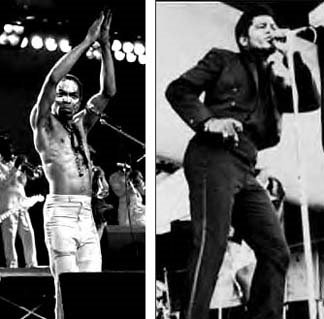
The Fela/James Brown Connection
By David McDavittDisciples of Fela’s Afrobeat and of James Brown’s soul have always had mutual admiration. But a debate persists: who stole whose shit? Myths & rumors abound, but the answer is as complex as the perpetual musical cross-pollination between Africa & the Americas. Both influenced each other. It's a universal truth: ‘bad cats recognize other bad cats, and often covet their particular funk’.
In the mid 1960’s Fela was star-struck by the heavy groove and conspicuous success of James Brown and local JB proponent Geraldo Pino (Sierra Leone). Fela said, “his equipment… something else… he came in a big way… one of those big American cars. Flashy new equipment. Lots of bread. He had everything I didn’t have…I had seen the impact this motherfucker had in Lagos… he had everyone in is pocket… I knew I had to get my shit together quick!” (excerpted from Fela, Fela, This Bitch of a Life, by Carlos Moore 1982).
But James Brown’s band also came to hear Fela perform at the Shrine, and attempted to capture some of his “African feel”. Here is are excerpts from interviews with Tony Allen & Bootsy Collins (JB’s bassist) from The Guardian:
"Tony Allen, Fela's drummer and a key architect of Afrobeat, claims that Brown sent his arranger, David Matthews, to check him out. 'He watches the movement of my legs and the movement of my hands, and he starts writing down ... They picked a lot from Fela when they came to Nigeria. It's like both of them sort of influenced each other. Fela got influenced in America, James Brown got the influence in Africa.’
When James Brown toured Nigeria in 1970, bassist William 'Bootsy' Collins recalls, '[Fela] had a club in Lagos, and we came to the club and they were treating us like kings. We were telling them they're the funkiest cats we ever heard in our life. I mean, this is the James Brown band, but we were totally wiped out! That was one trip I wouldn't trade for anything in the world.'"
For the full text of the interview, click here. "The Big Fela"
**
In another interview, Bootsy also stated, "I thought THEY were the greatest, period. Even before I got
into James Brown's band, the James Brown band was number one to me. But once I got there and saw Fela and them, then I had second thoughts about it....when I heard these cats, it was like another dimension... a deeper feel to me...it was like, 'Man, this is IT. We gotta try to be like this!' [laughs]..." (Excerpted from Jaybabcock.com.)
***********
This is an interview with David Matthews (James Brown’s arranger) from the Red Bull Music Academy.
“DAVID MATTHEWS: »It was the most amazing thing I had ever heard. It was the early years of what Fela had called the ’Afrobeat’. And to some degree it incorporated James’ style and rhythms. They had a James Brown rhythm section, plus 8 percussionists, doing the African rhythm thing. And it was – you couldn’t sit down when they were playing. It was just so infectious, it was an amazing experience.«
RBMA: »…You in fact, were impressed with Fela’s arranging.«
DM: »Yes.«
RBMA: »Did you bring any of that back when you were working with Bootsy and the guys?«
DM: »Yes, I did. In fact some Nigerian kid gave me a tape of some of his stuff. And then Fela heard about it and he thought James was trying to steal his shit. And he was angry! But I did try – some of those feels that I heard Fela and his band play in Lagos…I did try to record some of that feeling with Bootsy, and Clyde, and Catfish.«…”
For the full text of the interview, click here.
Friday, April 21, 2006
“Lead Congas” in Afrobeat
By David McDavittIn Fela’s Afrobeat, 3 or more conga players were counted among the percussionists. Two (or more) of these played “Rhythm Conga”- adopting the role of support drums in tribal ensemble music. Each drummer held down an unchanging tumbao on one full-sized conga drum, helping to weave the hypnotic polyrhythmic foundation on which the melodic instruments floated.
The remaining percussionist played “Lead Congas”- a set of 3 small Yoruba congas, known as Akuba. These drums are part of the “Odigo” ensemble of drums, related to the Gbedu, (often replacing bata in neo-traditional ceremonial usage) . They are tuned major thirds apart, and have a pleasing organic woody sound. In Afrobeat context, these drums are played with sticks, and adopt a lead or master drum role- free to improvise (in the jazz sense), embellish, highlight, add tension, direct/respond to dancers, as well as play highly melodic, & less rigid ostinatos. This player also usually had a set of 3 bells (mounted African gongs or cowbells). Fela often took solos on the Akuba drums in his later career (see “Fela Live”). The beginning of J.J.D. features an intro solo on the Akuba.
Femi Kuti replaced this lead conga set with bongos and timbales.
Check out Lagbadja’s website for more information on Akuba.
The United States of Afrobeat
By David McDavittAlthough Afrobeat is a decidedly Nigerian musical form, it is intrinsically linked with the USA. Afrobeat incorporates drum-kit (an American invention) & other electrified Western instruments as the chosen vehicle of presentation. Also, Fela emulated the band organization & soul stylings of James Brown’s band due to its sheer power, funkiness, and popularity/success. Afrobeat compositions have Western structure (distinct support & solo sections, strict song forms). Afrobeat is harmonically rooted in modes of US jazz, classical, & soul. Perhaps most importantly, America put the protest, politics, & anger in Fela’s music (and really, who isn’t enraged by the US). Fela stated he “discovered” Africa in the USA (i.e. consciousness of protest politics & Black pride/power), studying Malcolm X and the civil rights movement with Sandra Izsadore (an active Black Panther). Fela was inspired to promote pride in African heritage, encourage pan-Africanism, & fight colonialism. And finally, the current renaissance of Afrobeat music is most ubiquitously represented in America. This includes two of the great pioneers of the Afrobeat resurgence (the Daktaris, & spinoff, Antibalas), and over half of the 40 actively performing Afrobeat bands. Ifa bless the good ole United States of Afrobeat!
Thursday, April 20, 2006
History of the Name "Afrobeat"
By David McDavitt
What’s in a name? In 1969 Fela coined the term, “Afrobeat” to describe his new amalgam of Yoruba, highlife, soul & jazz. Quoth Fela, “I was playng highlife when Geraldo Pino came to town in ’66… that’s what upset everything, man. He came to town singing James Brown’s music…. Made me fall right on my ass, man… I went to Ghana shortly after… Pino was playing there… To me it was swinging music. I say, ‘Look the drummer, how he play drums! Ohhhhh, I say… this is heavy-o’… One day I was sitting in a club in Accra, listening to soul music… Everybody was playing soul, man, trying to copy Pino… I said to myself: ‘I have to be very original … and clear myself from this mess. I must identify myself with Africa… I must give it a name-o, a real African name that is catchy… I’ve been thinking of calling it 'Afrobeat' ' (Carlos Moore, Fela Fela- This Bitch of a Life, 1982).
Thirteen years later, Fela stated, “How do I define my music? People continue to call it Afrobeat. I call it ‘African Music’. But African music is so extensive…. Let’s call it ‘African music by Fela,’ then. Finish!” (Carlos Moore, Fela Fela- This Bitch of a Life, 1982).
The name “Afrobeat” survives, but in a 1992 interview, Fela denounced the term as, “a meaningless commercial nonsense with which the recording labels exploited the artist.” (excerpted from Sola Olarumyomi, Afrobeat! Fela and the Imagined Continent, 2003)
Of late Femi Kuti employs the moniker “Afrobeat” while Tony Allen alternates between “Afrobeat” and “Afrofunk”.

What’s in a name? In 1969 Fela coined the term, “Afrobeat” to describe his new amalgam of Yoruba, highlife, soul & jazz. Quoth Fela, “I was playng highlife when Geraldo Pino came to town in ’66… that’s what upset everything, man. He came to town singing James Brown’s music…. Made me fall right on my ass, man… I went to Ghana shortly after… Pino was playing there… To me it was swinging music. I say, ‘Look the drummer, how he play drums! Ohhhhh, I say… this is heavy-o’… One day I was sitting in a club in Accra, listening to soul music… Everybody was playing soul, man, trying to copy Pino… I said to myself: ‘I have to be very original … and clear myself from this mess. I must identify myself with Africa… I must give it a name-o, a real African name that is catchy… I’ve been thinking of calling it 'Afrobeat' '
Thirteen years later, Fela stated, “How do I define my music? People continue to call it Afrobeat. I call it ‘African Music’. But African music is so extensive…. Let’s call it ‘African music by Fela,’ then. Finish!” (Carlos Moore, Fela Fela- This Bitch of a Life, 1982).
The name “Afrobeat” survives, but in a 1992 interview, Fela denounced the term as, “a meaningless commercial nonsense with which the recording labels exploited the artist.” (excerpted from Sola Olarumyomi, Afrobeat! Fela and the Imagined Continent, 2003)
Of late Femi Kuti employs the moniker “Afrobeat” while Tony Allen alternates between “Afrobeat” and “Afrofunk”.
Host: David McDavitt
David McDavitt is the drummer for Chopteeth Afrofunk Big Band. Since first punching through the fragile paper heads of a toy drum kit at age seven, drums have been David's madness. He specializes in Ewe, Akan, & Ga music, often orchestrating tribal ensemble drum parts onto his Afrotrap kit. David has celebrated his passion for Highlife, Afrobeat, Juju, Soukous, and Mbalax, playing with the Afropop bands Elikeh, Baalim, A Different Drummer, & Big Village. David's influences include Fela, Raam Daan, Sekouba Diabate, Thomas Mapfumo, Fatala, Youssou N'Dour, Spinal Tap, & The Police. David directs a children's African drum ensemble in Arlington, VA.
Wednesday, April 19, 2006
Randy Weston Amazes
By Robert FoxIn January, I had the great privilege to see Randy Weston perform with his quintet at The Kennedy Center in Washington, DC. The legendary Brooklyn-born jazz pianist has spent a lifetime incorporating African rhythms into his music, and the show was one of the most moving performances I have ever seen.
Despite turning 80 this year, Weston was in top form. I was thrilled to hear him deliver an epic version of "Blue Moses" from the "Spirits of our Ancestors" album, one of my favorite recordings of all time. As Weston fans know, he spent his early career in the 1940s and 1950s mastering an innovative hard bop piano style along with contemporaries such as Thelonius Monk, then spent time in Nigeria in the early 1960s before moving to Morocco in 1968.
Since then he has released a string of African-influenced recordings that develop a highly individual rhythmic style with few parallels. One recent recording paired Weston with the Master Gnawa Musicians of Morocco, who perform live with him on "Spirit! The Power of the Music." Seeing Randy Weston was one of the absolute highlights of my musical experience--don't miss the rare opportunity if he comes your way.
I also can't resist pointing out that Weston performed with the incomparable Alex Blake on bass, who nearly stole the show with his uniquely percussive playing. Blake normally plays the stand-up bass while sitting down to better enable him to strum the strings, slap the body of the bass, stomp his feet, sing and generally carry on while simultaneously pounding out an intense and solid rhythm. Blake was born in Panama, and is one of the most creative and dynamic bass players anywhere, in my opinion. His recent live recording "Now Is The Time: Alex Blake Quintet Live at The Knitting Factory" is profound and worth seeking out (subject of a future post).
Randy Weston was also joined by Senegalese percussionist Abdou Mbop as well as the other members of his regular group: Neil Clark on drums and percussion (mostly no drumsticks, hands only!), Benny Powell on trombone and Talib Kweli on saxophones.
Check out the nice overview of Randy Weston from Down Beat Magazine, and also the overview and discography from the Europe Jazz Networks website. Randy Weston provided a thoughtful 2003 interview to All About Jazz on their website here.
Tuesday, April 18, 2006
Khaled on Rai
By Michael ShereikisHere's an interesting note on Algerian rai music by rai superstar Khaled. This is taken from an interview conducted by Banning Eyre in 2004 for Afropop Worldwide:
"If you look at the history of blues and jazz, you find the history of rai. Jazz and blues is about people who are suffering, people who are hungry. They made blues because it was like their religion—telling
stories, saying words of suffering, of life. And also, there were no notes to write down. You don't write it down. The music of the cheikhas, you can't write it. Their big instrument was the gasba. ... At that time, when people went to weddings, had evenings among friends, when the gasba played, there was no microphone. They heard only a cheikh, the poet. Because there was no melody. It was poetry, people telling stories. Love stories. It's like rock-and-roll talks about peace and love. That's cool. I want to play that. I like that. I want to be in love. I want to break the taboos. I want to be human, drinking. It's not bad. It's what I feel. Rai was that, people in love, people who want to hear a story, because they feel bad. When the poets wrote, they wrote their own stories, but they touched other people, because it's the same line for everyone. That's why I say rai sings the life of everyday. "For the full text of the interview, click here.To listen to song samples and buy Khaled's music, click here.
Monday, April 17, 2006
When Music is Business in Africa
By Michael Shereikis Before the current crisis, the Ivory Coast was considered the launchpad for West African music, the undisputed industry hub in the region. Why then has there been no distinctively Ivoirian musical form that has resonated significantly outside its borders (with rare, single song exceptions)? This is a question which preoccupied my head while living in Abidjan in the late 90s, and it is an excellent case study in the articulation of market forces (global and local) with local music making. Here are a few bullet points to begin thinking about this subject:
1. In Ivory Coast, performance IS studio recording. Live music was supplanted by DJs and by "playback" (lip-syncing) beginning in the 80s and continuing through today. The only way to make it as a performer (unless you've got mad $$) is to record, release your recording and then lip-sync in concert with a stable of artists, usually 2-3 songs each.
2. In order to record you need money, which for the majority of Ivoirian artists means finding a producer who will invest in your art.
3. The vast majority of producers want to do two things: save money and make money. To save money they record in tiny little closet studios virtually all on MIDI sequencers. To make money, they are excessively risk averse and far too often will ignore an artist's vision in favor of packaging the artist in the hot sound of the day. They also screw the artists unmercifully when it comes to sharing any proceeds not consumed by piracy.
4. There are only as many arrangers as there are little studios, likely fewer. These arrangers are defined as guys that can manipulate the computer-based recording equipment used in these mini studios. They work for the producer, and so give him what he wants. Often the artist is not even present during the creation of a backing track. This is at the root of the "cookie-cutter" effect felt so distinctly in Abidjan in particular.
5. The end result is a local scene characterized by very little innovation, virtually no "bands" or live concerts to speak of (with some exceptions), and most disheartening, entire generations of artists whose artistic vision is subjegated to market forces (to say nothing of the plight of the instrumentalist "gomboist"). Sure, you can bob your head and smile to Mapouka or Coupe Decalle, but it leaves you hungry for something of substance. It's like crack.
6. The irony is that much of the MIDI sequencing is perceived by its practitioners as infusing an element of modernity into the essentially organic creations that young, poor artists begin with (acoustic guitar, djembe, voice). But this same sequencer-based sound is what virtually disqualifies the local music from any sort of success in the "world music" market, which places higher value on organic, "authentic" sounds.
7. Another irony is that often an artist will be ignored at home for doing something too "folklorique" or too country. But if that same artist enjoys even a patina of success overseas (particuarly in Western Europe or the US), then they are much better able to succeed in their local market.
Again, these are just quick thoughts on the subject, but you get the picture, non? Now what are we going to do about it?
Music of Ivory Coast
Sunday, April 16, 2006
Easter Greetings
By Michael Shereikis"Through Jesus Christ our Lord [AMEN-AMEN-AMEN]
By the grace of almighty Lord [AMEN-AMEN-AMEN]
Through Jesus Christ our Lord [AMEN-AMEN-AMEN]
By the grace of almighty Lord [AMEN-AMEN-AMEN]
Inspiritus Christus, Mass Christus, Mass Christus, Mass Christus
[AMEN-AMEN-AMEN]
Allahu Wakbar, Hamadu Salaam Alekum, Allah!
[AMEN-AMEN-AMEN]
Through Jesus Christ our Lord [AMEN-AMEN-AMEN]
By the grace of almighty Lord [AMEN-AMEN-AMEN]
So me waka waka waka..."
- lyrics from Coffin for Head of State by Fela Kuti
---**---
"...the Archbishop has much pleasure/the Pope has much enjoyment/Imam has good times."
- Fela Kuti
Saturday, April 15, 2006
Gnawa Notes
By Michael Shereikis Likely you've dipped into the bassy groove of Gnawa music already. If not, it is definitely worth experiencing. Gnawa are the descendents of slaves brought across the Sahara to North Africa, and in particular, Morroco. Their music and culture have not only survived the ordeal, but taken on a fascinating character, with equal footing in its sub-saharan origin and North African home. If you haven't checked it out yet, check it out now!
If you've heard the sound and want to fill in some context, here are a couple places to begin. Otherwise just google "Gnawa":
Gnawa Stories, an interactive webpage distilling Gnawa historical and cultural information in an easy to navigate format. Click on Resources for a decent list of recordings. If you want more, check out Cybergnawas, and Gnawa.net,
Hassan Hakmoun's website, one of the most well-known gnawa musicians recording today.
And of course there's always Gnawa Music on Amazon.com
Thursday, April 13, 2006
Jean Bosco Revisited
By Michael Shereikis
Congolese guitarist Jean-Bosco Mwenda (aka, Mwenda wa Bayeke), was one of the most popular and innovative musicians of his day across central, eastern and southern Africa. Beginning in the early 50s, Bosco's signature syncopated, finger-picked guitar sound made him much in demand throughout the region, and took him as far as Europe and even an appearance at the Newport Jazz Fest in '61.
When electrified rumba bands began developing that new, all-consuming sound in Congo in the late 60s, Bosco stuck to his original formula and his music was relegated to the status of "oldies." But it was on the shoulders of Bosco and artists like him that this new music firmly rested. When you listen to Bosco play and sing, the line of continuity is abundantly clear from what he was doing to what we hear today from even the most hyped-up Congolese superstars.
Recorded in Cape Town in 1988, and re-released by Rounder in 1995, this CD represents Jean-Bosco's final recording session. He is recorded solo with guitar, likely a rarity for him, and even allows an instrumental version of one of his most famous tunes, Masanga. Excellent liner notes as well.
If you are a guitarist, I urge you to pick one Bosco tune and figure out how to play it. You'll learn a ton in the process. Once you've accounted for all the sounds Bosco is making, try singing along...
Congolese guitarist Jean-Bosco Mwenda (aka, Mwenda wa Bayeke), was one of the most popular and innovative musicians of his day across central, eastern and southern Africa. Beginning in the early 50s, Bosco's signature syncopated, finger-picked guitar sound made him much in demand throughout the region, and took him as far as Europe and even an appearance at the Newport Jazz Fest in '61.When electrified rumba bands began developing that new, all-consuming sound in Congo in the late 60s, Bosco stuck to his original formula and his music was relegated to the status of "oldies." But it was on the shoulders of Bosco and artists like him that this new music firmly rested. When you listen to Bosco play and sing, the line of continuity is abundantly clear from what he was doing to what we hear today from even the most hyped-up Congolese superstars.
Recorded in Cape Town in 1988, and re-released by Rounder in 1995, this CD represents Jean-Bosco's final recording session. He is recorded solo with guitar, likely a rarity for him, and even allows an instrumental version of one of his most famous tunes, Masanga. Excellent liner notes as well.
If you are a guitarist, I urge you to pick one Bosco tune and figure out how to play it. You'll learn a ton in the process. Once you've accounted for all the sounds Bosco is making, try singing along...
Wednesday, April 12, 2006
Mulatu Astatke: Ethiopian Cool
By Michael Shereikis
Buda Music is a French label that's been releasing some really excellent re-issues, live concert recordings, and musical eclectica from all over. Their catalog is truly wonderful. In particular though, their "Ethiopiques" series has been a revelation for me. I had no idea this sound was so vibrant in Ethiopia in the 60s-70s. This is some very cool stuff, very suave, yet somehow maintaining an edge. I'm listening to Ethiopiques vol.4: Ethio jazz & musiques instrumentale, 1969-1974 today as I paint my living room, and it's getting me through just fine. It features the instrumental big band sound of Mulatu Astatke, king of the ethio jazz movement. If you mix in a little TP OK Jazz, you can paint for hours...
Check out Mulatu Astatke on Amazon.com
Buda Music is a French label that's been releasing some really excellent re-issues, live concert recordings, and musical eclectica from all over. Their catalog is truly wonderful. In particular though, their "Ethiopiques" series has been a revelation for me. I had no idea this sound was so vibrant in Ethiopia in the 60s-70s. This is some very cool stuff, very suave, yet somehow maintaining an edge. I'm listening to Ethiopiques vol.4: Ethio jazz & musiques instrumentale, 1969-1974 today as I paint my living room, and it's getting me through just fine. It features the instrumental big band sound of Mulatu Astatke, king of the ethio jazz movement. If you mix in a little TP OK Jazz, you can paint for hours...Check out Mulatu Astatke on Amazon.com
Tuesday, April 11, 2006
Princes of Musique Mandingue
By Michael Shereikis
If you haven't already checked out Ba Cissoko's latest album, Sabolan, you may want to have a look. Guinean Ba Cissoko (kora) comes from mande musical royalty (son of Kandara Cissoko, founder of Ballet Djoliba), and has teamed up with Sekou Kouyaté (traditional and electric koras) and Kourou Kouyaté (electric bass), both sons of the great kora master, M'bady Kouyate. Together with Ibrahima Bah on percussion, this band is generating some fierce sounds that stretch the boundaries of traditional mandingue music. Purists may howl, but it will only add to the energy of this hard driving quartet. Brilliant musicians, and sons of mandingue musical royalty, Ba Cissoko is just the sort of group that keeps a musical tradition living and breathing.
More info on Ba Cissoko:
Listen to samples from Sabolan
Ba Cissoko at WOMAD 04
Ba Cissoko at New Zealand International Arts Festival 06
Biography of Ba Cissoko on the Radio France International website
If you happen to be in the DC area, Ba Cissoko is performing at La Maison Francaise on Thursday, April 20th. Reservations are required.
If you haven't already checked out Ba Cissoko's latest album, Sabolan, you may want to have a look. Guinean Ba Cissoko (kora) comes from mande musical royalty (son of Kandara Cissoko, founder of Ballet Djoliba), and has teamed up with Sekou Kouyaté (traditional and electric koras) and Kourou Kouyaté (electric bass), both sons of the great kora master, M'bady Kouyate. Together with Ibrahima Bah on percussion, this band is generating some fierce sounds that stretch the boundaries of traditional mandingue music. Purists may howl, but it will only add to the energy of this hard driving quartet. Brilliant musicians, and sons of mandingue musical royalty, Ba Cissoko is just the sort of group that keeps a musical tradition living and breathing.More info on Ba Cissoko:
Listen to samples from Sabolan
Ba Cissoko at WOMAD 04
Ba Cissoko at New Zealand International Arts Festival 06
Biography of Ba Cissoko on the Radio France International website
If you happen to be in the DC area, Ba Cissoko is performing at La Maison Francaise on Thursday, April 20th. Reservations are required.
Monday, April 10, 2006
Geraldo Pino Back in the Mix!
By Michael Shereikis
The geniuses at RetroAfric have done it again. There have long been rumors of groundbreaking afrufunk by Sierra Leonian bandleader Geraldo Pino (aka Gerald Pine), but not until this recent re-release by RetroAfric have we been able to experience his music in such a heavy, heavy dose.
Not only are the grooves just deliciously phat, but the sound quality is much better than one might expect from a 60s era recording from Africa. Pino himself was an engineer, and his commitment to good sound just makes this recording all the more satisfying.
Here are a few comments from Fela himself about Pino's impact on the Nigerian scene (from the liner notes):
"I was playing highlife jazz when Geraldo Pino came to town in '66 or a bit earlier with soul. That's what upset everything man. He came to town with James Brown's music, singing, Hey, hey, I feel all right, ta ta ta ta... And with such equipment you've never seen, man. This man was tearing Lagos to pieces."
"...[Pino] came in a big way: in a convertible Pontiac; you know, one of those big American cars, man. Flashy, new equipment. Lots of bread. He was doing his thing, man. He had everything I didn't have."
"After that mother$*%!ing Pino tore up the scene, there wasn't shit I could do in Lagos. So I went to Ghana in '67... At that time that's where the action and the bread was. So, we went to Ghana. After seeing this Pino, I knew I had to get my shit together. And quick!"
(excerpted from Fela, Fela, This Bitch of a Life, by Carlos Moore 1982)
Buy "Heavy, Heavy, Heavy" at RetroAfric
The geniuses at RetroAfric have done it again. There have long been rumors of groundbreaking afrufunk by Sierra Leonian bandleader Geraldo Pino (aka Gerald Pine), but not until this recent re-release by RetroAfric have we been able to experience his music in such a heavy, heavy dose.Not only are the grooves just deliciously phat, but the sound quality is much better than one might expect from a 60s era recording from Africa. Pino himself was an engineer, and his commitment to good sound just makes this recording all the more satisfying.
Here are a few comments from Fela himself about Pino's impact on the Nigerian scene (from the liner notes):
"I was playing highlife jazz when Geraldo Pino came to town in '66 or a bit earlier with soul. That's what upset everything man. He came to town with James Brown's music, singing, Hey, hey, I feel all right, ta ta ta ta... And with such equipment you've never seen, man. This man was tearing Lagos to pieces."
"...[Pino] came in a big way: in a convertible Pontiac; you know, one of those big American cars, man. Flashy, new equipment. Lots of bread. He was doing his thing, man. He had everything I didn't have."
"After that mother$*%!ing Pino tore up the scene, there wasn't shit I could do in Lagos. So I went to Ghana in '67... At that time that's where the action and the bread was. So, we went to Ghana. After seeing this Pino, I knew I had to get my shit together. And quick!"
(excerpted from Fela, Fela, This Bitch of a Life, by Carlos Moore 1982)
Buy "Heavy, Heavy, Heavy" at RetroAfric
Miriam Makeba Says Goodbye
By Robert FoxMiriam Makeba is on her farewell tour at age 73, capping a lifetime of music, dance, exile and struggle. The anti-apartheid legend performed at The Cape Town International Jazz Festival on Friday, and was received with a level of respect "akin to worship of a deity" by the hometown crowd, as described in The Standard (Kenya).
The Guardian also saluted Miriam Makeba recently for her decades of struggle against apartheid as "an icon of resistance," noting that "along with Fela Kuti and Hugh Masekela, Makeba put African music on the world map."
The Standard quoted Makeba giving this moving farewell at her final Cape Town concert: In time we get older
"In time we get to mellow
I can’t change the hands of time
I have been through changes like everyone else
My heart has been troubled and put on the shelf
I love my children, more than anything.
iii…iii…iiiiiii…basi hapo zamani mama shauri ya pombe…iye ye mama…
I want to say thank you to those who raised their voices against the injustices of apartheid.
We say thank you to those who raised their voices for we know that without their voices we would not stand
today and say we are free, we are free, and we are free.
We want to thank our children for the role they played in our freedom.
We want to thank the mothers for their prayers that saved the nation.
We want to thank our traditional healers for healing the nation
We want to thank our leaders who
taught us how to be patient and who told us that though we may never forget we must forget.
Maskani… am home.
Let us make this country the greatest of
all because we are going to give each other a hand and make it strong."
Host: Michael Shereikis
Michael Shereikis is a composer, guitarist and vocalist for Chopteeth Afrofunk Big Band. His fascination with African guitar styles began as a Peace Corps volunteer in the Central African Republic. He subsequently honed his skills playing with local recording artists in New Orleans and in Abidjan (Cote d'Ivoire), while pursuing an advanced degree in ethnomusicology. He is a founding member of the Ivoirian group Zieti and is currently producing their debut release in the US for Rootstock Productions. In addition to his first love, the old-school afrofunk of Chopteeth, Michael gigs and records with several other projects in the Washington DC area, including Elikeh, fronted by Togolese singer/songwriter Serges Dogo of Togo. Michael can be reached at rootstockproductions@msn.com.
Sunday, April 09, 2006
Thomas Mapfumo Digital Releases
By Robert FoxZimbabwe's prolific Thomas Mapfumo has announced the release of two new recordings in digital-only format over the last 12 months: the self-produced "Rise Up," and an historic 1991 live performance recorded at SOB's in New York City.
Both recordings were published through Calabash Music, "the world's first fair trade music company," which says that half of all retail music sales go directly to the artists--a much greater percentage than in the traditional analog business model. The 1991 show was recorded by Afropop Worldwide, whose Sean Barlow calls the result "one of the most sublime Afropop recordings ever made." Calabash is also said to be planning a 130 song download-only "boxed" set of all of Mapfumo's recordings, although the boxed set is not currently available on the website, and only one of the songs from "Rise Up" is available. They will be worth waiting for.
Thomas Mapfumo was a hero of the Rhodesian liberation struggle, and has since been exiled from Zimbabwe for his uncompromising pro-democracy stands. However, his dynamic Chimurenga music continues to inspire social justice activists around the world.
Saturday, April 08, 2006
New Album From Nuru Kane
By Robert FoxThis month, there was an interesting new album released by Nuru Kane of Senegal, the guitarist and guimbri player who also leads the group Bayefall Gnawa. Titled "Sigil," the debut solo album from Riverboat Records combines traditional Gnawa rhythms with a blues sensibility and an ear for pulsing Mbalax that make you want to move. The mostly acoustic recordings were said to have been recorded virtually live in studios in Scotland and Paris, but they have an electric and complex feel that will connect with Afrobeat fans.
You can check out a couple of song samples on Nuru Kane's myspace site. I like this sound.
Riverboat Records offers a nice promotional podcast of Nuru Kane with song samples from the album, plus live recordings and interviews.
Nuru Kane is currently touring the UK with a five piece band, and it would be great to hear a report from anyone who has been able to see one of the shows---post a comment if you've seen one of the recent performances. I'm looking forward to a chance to see Nuru Kane in the US.
Friday, April 07, 2006
Toumani Diabate Strikes Again
By Robert FoxThe Malian kora wizard Toumani Diabate released a new album last week that is already making big waves. The so-called "Jimi Hendrix of the kora," he is widely considered one of the world's greatest players of the instrument. His funky new big band, The Symmetric Orchestra, has put a fresh groove into the ancient griot tradition.
The new album, Boulevard De L’Independence is receiving critical adoration and is turning heads worldwide for its mix of old and new. It was recorded at the Hotel Mande in Bamako at the same time as "In The Heart of the Moon," the 2005 Grammy Award winning collaboration with Ali Farka Toure. The album features blistering kora on top of a funky groove that includes former James Brown horn section leader Pee Wee Ellis.
There is a nice review of the new album today on the Fly Global Culture and Music website ("I want to show how far I can push the improvisation, I am for sheer technical brilliance").
Fly also has a front-page feature and interview with Toumani Diabate where he discusses his current blend of modern music, kora and ancient traditions---here is a taste:
“Where is Toumani?” vocalist Soumaila Kanoute sings every Friday night in a small bar in Bamako called Hogon. “Toumani has arrived!” he announces as an unassuming man, carrying a four-foot high 21-stringed harp-lute known as a kora, takes centre stage. And every Friday night the expectant crowd erupts in song and dance to the African star’s latest project: Toumani Diabate’s Symmetric Orchestra.
It appears that the CD and bonus DVD are available only in England as of this date. You can order "Boulevard De L'Independence" and listen to song samples here.
Thursday, April 06, 2006
Orchestra Baobab Still Has It
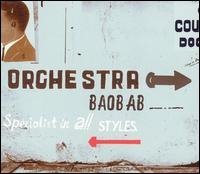
By Robert FoxI recently saw Senegalese masters Orchestra Baobab at The Birchmere in Arlington, Virginia, just outside of Washington, DC. As you would expect, they were incredible: super-tight arrangements, dynamic Afro-Cuban groove, sharp stage presence, and with their unique and intoxicating flair. No one does it better. It was a special opportunity for African music fans in the DC area, although anyone familiar with their Nonesuch release "Specialists In All Styles" wouldn't be surprised---their set was note-for-note organized around the CD arrangements. Very impressive.
Here is the Allmusic.com review of "Specialists in All Styles:"
Putting a classic band together 15 years after their demise can be a recipe
for disaster. In this case, though, World Circuit head Nick Gold has definitely
done the world a favor. Orchestra Baobab might be best known for their classic
Pirate's Choice, but this disc is every bit the equal — it's most certainly not
Buena Vista Baobab Club.
For someone who hadn't touched a guitar in years, after
becoming a lawyer in his native Togo, Barthelemy Attisso is all over this
record, offering beautiful, inventive solos and playing whose fluidity,
especially on "Gnawe" and "Dee Moo Wor," is wonderfully atmospheric.
As any fan would expect, the Cuban influence remains very strong,
but the Wolf roots are also strong, especially in the voice of
young singer Assane Mboup. Guest turns
from Ibrahim Ferrer and co-producer Youssou N'Dour on "Homage a Tonton Ferrer" — a remake of "Utru Horas," their biggest song — aren't going to hurt the album's visibility. But ultimately it's the band themselves who carry the record, playing better than ever (not only the superb Attisso, but also saxman IssaCissokho). Back in fine style, indeed."
Wednesday, April 05, 2006
JB on Soul Train 1973
By Robert Fox
Check out this vintage footage of James Brown from the Soul Train TV show, 1973. It's with Damita Jo Freeman dancing. That's one tight band---the shift into the main part of the tune is vacuum-sealed.
The Soul Train graphic/audio tag at the end brings back memories. Why can't TV still be like this?
Check out this vintage footage of James Brown from the Soul Train TV show, 1973. It's with Damita Jo Freeman dancing. That's one tight band---the shift into the main part of the tune is vacuum-sealed.
The Soul Train graphic/audio tag at the end brings back memories. Why can't TV still be like this?
Tuesday, April 04, 2006
Fela Kuti's Wikipedia Listing
By Robert Fox
Wikipedia has a very nice entry on Fela.
Many people are now familiar with a wiki: it's a website where any site visitor can edit or change the content. Someone who goes to the site after you can change what you wrote, and the next person after that can change it again. And so on. In some situations wikis produces excellent results, which is somewhat counter-intuitive.
It's a concept based on the idea of the iterative intelligence of decentralized groups of people, which is explained in a book called The Wisdom of Crowds by James Surowiecki. The idea is that large decentralized groups of people working on a problem can often come up with an answer that is better than that of any one individual in it.
Sound like Afrobeat? Check out the entries on Fela and Afrobeat and add your own perspective. Here is a sample of the Fela entry on Wikipedia--a little dry, but to-the-point:
The musical style performed by Fela Kuti was called Afrobeat, which was essentially a fusion of jazz, funk and Traditional African Chant. It was characterized by having African style percussion, vocals, and musical structure, along with jazzy, funky horn sections. The "endless groove" was also used, in which a base rhythm of drums, muted guitar, and bass guitar are repeated throughout the song. This is a common technique in African and African-influenced musical styles, and can be seen in funk and hip-hop. Fela's songs were almost always over ten minutes in length, some reaching the twenty or even thirty minute marks... Fela refused to perform songs again after he had already recorded them, which also hindered his popularity outside Africa. Fela was known for his showmanship, and his concerts were often quite outlandish and wild.
Anyone out there want to spice up Fela's entry? Just click on the "edit" button at the end of each paragraph on the Wikipedia site, and enjoy your 15 minutes of fame!
Wikipedia has a very nice entry on Fela.
Many people are now familiar with a wiki: it's a website where any site visitor can edit or change the content. Someone who goes to the site after you can change what you wrote, and the next person after that can change it again. And so on. In some situations wikis produces excellent results, which is somewhat counter-intuitive.
It's a concept based on the idea of the iterative intelligence of decentralized groups of people, which is explained in a book called The Wisdom of Crowds by James Surowiecki. The idea is that large decentralized groups of people working on a problem can often come up with an answer that is better than that of any one individual in it.
Sound like Afrobeat? Check out the entries on Fela and Afrobeat and add your own perspective. Here is a sample of the Fela entry on Wikipedia--a little dry, but to-the-point:
The musical style performed by Fela Kuti was called Afrobeat, which was essentially a fusion of jazz, funk and Traditional African Chant. It was characterized by having African style percussion, vocals, and musical structure, along with jazzy, funky horn sections. The "endless groove" was also used, in which a base rhythm of drums, muted guitar, and bass guitar are repeated throughout the song. This is a common technique in African and African-influenced musical styles, and can be seen in funk and hip-hop. Fela's songs were almost always over ten minutes in length, some reaching the twenty or even thirty minute marks... Fela refused to perform songs again after he had already recorded them, which also hindered his popularity outside Africa. Fela was known for his showmanship, and his concerts were often quite outlandish and wild.
Anyone out there want to spice up Fela's entry? Just click on the "edit" button at the end of each paragraph on the Wikipedia site, and enjoy your 15 minutes of fame!
Monday, April 03, 2006
Miami Funk 1967-74
By Robert Fox
In 2003, the UK's Soul Jazz label released a superb collection or rare and previously "lost" hard funk classics from Miami's fertile music scene of the late 1960s and early 1970s. The album was titled "Miami Sound: Rare Funk & Soul from Miami Florida 1967-1974," and it includes a brilliant set of chunky, sweaty grooves from local Miami artists who never hit the big time but who could obviously Bring It in a serious way.
This was powerful, raw music, recorded low-fi, but with a swinging energy and an all-around strutting attitude influenced by James Brown, Stax Records and the Afro-Cuban grooves drifting over Miami radio. It's a winning combination, and many of these tunes deserve to be classics: "Funkadelic Sound" by Little Beaver; "Cramp Your Style" by All The People; "Do It To Me One More Time," Joey Gilmore; "Fantasy World," James McKnight, etc.
You can check out some song samples from the CD on the Barnes and Noble website.
For 2006, "The Godfather of the Miami Sound," producer Henry Stone, has added two additional volumes of Miami Funk from the same era. They are released under his own label as "Henry Stone Presents Miami Funk Volumes 1 and 2." If anything, these two CDs only increase the temperature further by digging deep into the Miami funk archives.
The new releases feature four-alarm jams such as: "Funky In the Hole" (you know which one) by The Blowflys; "Mashed Potato Popcorn" by Freddie and the Kinfolk; "Groove On" by The Famous Chromes; and "Nasty Dog" by The Mighty Dog Catchers. Mmmmmmm, funky!
Check out some song samples of the new releases and buy CDs on the Henry Stone website, or listen to the songs on Rhapsody and other streaming services if you have access to their networks. Have the fire extinguisher ready, however---this is hot stuff!
In 2003, the UK's Soul Jazz label released a superb collection or rare and previously "lost" hard funk classics from Miami's fertile music scene of the late 1960s and early 1970s. The album was titled "Miami Sound: Rare Funk & Soul from Miami Florida 1967-1974," and it includes a brilliant set of chunky, sweaty grooves from local Miami artists who never hit the big time but who could obviously Bring It in a serious way.
This was powerful, raw music, recorded low-fi, but with a swinging energy and an all-around strutting attitude influenced by James Brown, Stax Records and the Afro-Cuban grooves drifting over Miami radio. It's a winning combination, and many of these tunes deserve to be classics: "Funkadelic Sound" by Little Beaver; "Cramp Your Style" by All The People; "Do It To Me One More Time," Joey Gilmore; "Fantasy World," James McKnight, etc.
You can check out some song samples from the CD on the Barnes and Noble website.
For 2006, "The Godfather of the Miami Sound," producer Henry Stone, has added two additional volumes of Miami Funk from the same era. They are released under his own label as "Henry Stone Presents Miami Funk Volumes 1 and 2." If anything, these two CDs only increase the temperature further by digging deep into the Miami funk archives.
The new releases feature four-alarm jams such as: "Funky In the Hole" (you know which one) by The Blowflys; "Mashed Potato Popcorn" by Freddie and the Kinfolk; "Groove On" by The Famous Chromes; and "Nasty Dog" by The Mighty Dog Catchers. Mmmmmmm, funky!
Check out some song samples of the new releases and buy CDs on the Henry Stone website, or listen to the songs on Rhapsody and other streaming services if you have access to their networks. Have the fire extinguisher ready, however---this is hot stuff!
Sunday, April 02, 2006
John Pareles on The Music of Mali
By Robert Fox
The Sunday New York Times has a nice article on the music of Mali today by their senior music reviewer John Pareles. Since the major US papers don't spend a lot of time covering West African music, this was a pleasant surprise. Pareles highlights ten powerful albums from Mali and gives brief reviews of each. He has a long-term interest in African music and can write informatively about it.
Some of my all-time favorites are reviewed in the article, including "Worotan" by Oumou Sangare, which my wife and I had playing in the delivery room during the birth of our son Patrick seven years ago. It's a deep and resonant recording that means a lot to me.
(Other recordings we played that day in the hospital included King Sunny Ade's "Juju Music," Randy Weston's "Spirits of Our Ancestors," Baaba Maal's "Djam Leelii," Billie Holiday's Columbia recordings and Miles Davis/John Coltrane on "Kind of Blue." It took quite a while for my son to arrive, so we did some listening--I still have the compilation cassette tape I made afterwards from the various CDs).
The New York Times article has audio clips from each CD associated with the reviews, so you can check out samples. Here is John Pareles on the importance of history and tradition in Malian music, even as it has absored influences from around the world:
"HISTORY echoes through Malian music, new and old. It's in the ancient modal scales of the melodies, which can sound like American blues. It's in the circling, hypnotic vamps that those melodies soar above. It's in songs that might well be modern versions of the epics passed down by generations of the troubadours known as griots. And it's in the way electric guitars and synthesizers are often used to recall the pointillistic patterns of traditional instruments like the kora — the griot's traditional harp-guitar — and the balafon, an African xylophone.
In the 13th century, Mali was an empire, a cosmopolitan place where the cultures of northern and sub-Saharan Africa mingled. Malian music absorbed Islamic vocals, West African polyrhythms and, later, the sounds of Afro-Cuban music and American funk and rock."
Check out the full article here.
The Sunday New York Times has a nice article on the music of Mali today by their senior music reviewer John Pareles. Since the major US papers don't spend a lot of time covering West African music, this was a pleasant surprise. Pareles highlights ten powerful albums from Mali and gives brief reviews of each. He has a long-term interest in African music and can write informatively about it.
Some of my all-time favorites are reviewed in the article, including "Worotan" by Oumou Sangare, which my wife and I had playing in the delivery room during the birth of our son Patrick seven years ago. It's a deep and resonant recording that means a lot to me.
(Other recordings we played that day in the hospital included King Sunny Ade's "Juju Music," Randy Weston's "Spirits of Our Ancestors," Baaba Maal's "Djam Leelii," Billie Holiday's Columbia recordings and Miles Davis/John Coltrane on "Kind of Blue." It took quite a while for my son to arrive, so we did some listening--I still have the compilation cassette tape I made afterwards from the various CDs).
The New York Times article has audio clips from each CD associated with the reviews, so you can check out samples. Here is John Pareles on the importance of history and tradition in Malian music, even as it has absored influences from around the world:
"HISTORY echoes through Malian music, new and old. It's in the ancient modal scales of the melodies, which can sound like American blues. It's in the circling, hypnotic vamps that those melodies soar above. It's in songs that might well be modern versions of the epics passed down by generations of the troubadours known as griots. And it's in the way electric guitars and synthesizers are often used to recall the pointillistic patterns of traditional instruments like the kora — the griot's traditional harp-guitar — and the balafon, an African xylophone.
In the 13th century, Mali was an empire, a cosmopolitan place where the cultures of northern and sub-Saharan Africa mingled. Malian music absorbed Islamic vocals, West African polyrhythms and, later, the sounds of Afro-Cuban music and American funk and rock."
Check out the full article here.
Saturday, April 01, 2006
Soundway: Classic Afrofunk
By Robert FoxBritain’s Soundway Records is fast becoming the most important record label in the world when it comes to vintage Afrobeat and classic, 70s-era African influenced sounds. Starting with their crucial Ghana Soundz series (two CDs, volumes 1 and 2), Soundway is resurrecting dynamic and powerful music that was had previously fallen out of circulation.
The Ghana Soundz series re-released some astonishingly funky grooves from Ghana’s rich 1970s music scene, including gems from K. Frimpong and His Cubano Fiestas, Alex Konadu, The Sweet Talks, Marjiata and many other stars of the day. The recordings are a heavy dose of raw funk and sophisticated rhythms that richly deserve wider appreciation.
Soundway has also recently re-released new compilations by other seminal West African artists, including Orlando Julius, Geraldo Pino and TP Orchestra Poly-Rythmo. Soundway’s Afro Baby collection assembles some of the highlights from Nigeria’s explosion of innovative music in the early 1970s, inlcuding previously hard-to-find cuts from Fela Kuti, Bola Johnson, The Sahara All-Stars and more.
The latest output from Soundway includes vinyl releases of classic 70s West African and Caribbean jams, plus rare cuts from Orchestra Baobab, Mulatu Astatke of Ethiopia and a compiliation of grooves from Panama. This is A-team stuff that you won’t get anywhere else.
Soundway is doing Afrofunk fans a major favor with their thoughtful releases and careful research. All the CDs include extensive liner notes and nice packaging. I’ve really enjoyed the Soundway output, and collectors and musicians alike will really dig what they have to offer.
Check out more on Soundway and buy their CDs and vinyl here.
Here is the Soundway mission statement from their website—Right On!:
"Our mission is to release underground tropical
dance music with a funky flavour. With a philosophy of quality not quantity we
hope to delve deep into areas that have gone unnoticed, uncovering tasty musical
gems for the dance-floor and beyond. Our releases will all be accompanied by
detailed research and all will be fully licensed. Music from Africa, Latin
America the Caribbean that stands out as being original or different in some way
will be on our agenda – and of course we hope to hear from contemporary
musicians, producers and remixers whether they be from London, Lagos, Rio, or
Montreal who have been inspired by these sounds."
Afrofunk Music Forum is sponsored by Chopteeth