News, reviews and commentary on afrobeat and related music from Africa, The Caribbean and The Americas
Showing posts with label USA. Show all posts

Sunday, February 26, 2012

Fela Soul

By Robert Fox

Fun recent mashup of Fela and classic hip hop innovators De La Soul by producer Amerigo Gazaway of Gummy Soul, who describes the project as follows:
What do you get when you put together afrobeat legend Fela Kuti and rap pioneers De La Soul? You get Fela Soul, a musical tapestry created by Gummy Soul artist Amerigo Gazaway. More than just a clever title, Fela Soul is an 8-track, 33 minute journey into the world of afrobeat rhythms, funky horn riffs,  and classic hip-hop gems. Using dozens of  hand-picked samples from the Nigerian instrumentalist and political figure Fela Kuti, and 8 carefully-chosen acapellas from the Native Tongue rap trio De La Soul, Amerigo seamlessly intertwines the two into something completely new and original.
NPR singled it out as one of the best recordings of 2011 from the independnt music publishing site Bandcamp:
Fela Soul is the sort of mash-up album that never gets tired. The concept is fresh and simple: Take the music of Afrobeat legend Fela Kuti and marry it with the raps of De La Soul. Fela Soul is the work of Gummy Soul producer Amerigo Gazaway, who makes his ingredients sound as if they were born to be together. (There's also an instrumental version of the album that you can also download for free.) Nashville's Gummy Soul, a boutique soul and hip-hop label, was founded by Walter Clark and started as a radio show on Vanderbilt's WRVU.
All the tracks are available for legal streaming and downloading along with liner notes from the Gummy Soul Bandcamp site. Enjoy:


There's also a cool video to accompany the recordings:


Hat tip to Marc Gabriel Amigone of the always up-to-date Afrobeat Blog for the heads up.  

Saturday, February 25, 2012

Stevie Wonder: Signed, Sealed, Delivered

By Robert Fox

This is so funky that watching it nearly makes me pass out.  A very different twist on a classic tune, from a German television show in 1973.  It doesn't get much groovier than this. Gotta love Deniece Williams leading the backing vocals:

Thursday, June 17, 2010

FELA on Broadway wins 3 Tony Awards


FELA on Broadway no get enemy. In fact it has the enthusiastic support of the popular masses, and now official recognition from the Tony Awards.

Best Choreography: Bill T. Jones
Best Costume Design: Marina Draghici
Best Sound Design: Robert Kaplowitz

Everybody say, "Yeah Yeah!"

Wednesday, February 24, 2010

Steve McQueen Fela Film in Production


By David McDavitt

Whoever thought theater would be the savior of Afrobeat music? 100-plus afrobeat bands have been pounding away in relative obscurity for the last 15 years or so, delighting only the privileged few with the secret knowledge of Baba Kuti’s unique groove. Then along comes the powerful Broadway play, “Fela!” attracting an impressive pop following and critical acclaim, educating thousands about Afrobeat and “Felasophy.” Awesome. It’s powerful when your girlfriend’s 64 year old mother asks you to borrow some Fela CD’s.

No doubt in great thanks to “Fela!” on Broadway’s success, now Afrobeat fans will be treated to another miracle, a Fela Hollywood film!

Focus Features has hired British director Steve McQueen (“Hunger”) to direct, ad co-write the script with the award-winning, Nigeria-born playwright Biyi Bandele (adaptation of Chinua Achebe’s, “Things Fall Apart”/ Shakespeare Theater Co.).

"Fela might be the most globally influential pop artist outside the Beatles in the last 50 years," Focus Features’ James Schamus told Variety.

Everybody say, “yeah yeah!”

Wednesday, November 25, 2009

Louis Armstrong: “Nothin’ happen I ain’t never seen before.”


By Robert Fox

On television once, I saw some amazing interviews where people describe seeing Louis Armstrong's band in the 1920s. Early in Armstrong's career, the band traveled by paddle boat up the Mississippi River from New Orleans, stopping in every town along the way to play in the boat's ballroom.

In the interviews, various witnesses recall the overwhelming power, volume and rhythmic sophistication of those concerts on the paddle boat. It was before instruments were amplified, before radio and records were widespread, before modern jazz had ever been heard before. The big band was the Marshall stack of the era.

Given how fluid music is across borders these days, it's hard to imagine the searing impact Armstrong's band must have had at the time, especially in rural America. Some of the people interviewed described it as a life-altering experience that changed them forever, and made them want to become musicians from that moment forward.

Yesterday, there was a great article about Louis Armstrong by Michiko Kakutani in The New York Times. The piece is a review of a new biography by Terry Teachout, titled "Pops: A Life of Louis Armstrong." The review sums up nicely the musical tidal wave he created, a wave that still laps up on shores everywhere:
Louis Armstrong, a k a Satchmo, a k a Pops, was to music what Picasso was to painting, what Joyce was to fiction: an innovator who changed the face of his art form, a fecund and endlessly inventive pioneer whose discovery of his own voice helped remake 20th-century culture.
...
Mr. Teachout reminds us of Armstrong’s gifts: “the combination of hurtling momentum and expansive lyricism that propelled his playing and singing alike,” his revolutionary sense of rhythm, his “dazzling virtuosity and sensational brilliance of tone,” in another trumpeter’s words, which left listeners feeling as though they’d been staring into the sun.
...
“Even before his face became known to the readers of newspapers and illustrated magazines — and, later, to filmgoers and TV viewers,” Mr. Teachout writes, “Armstrong was the first jazz musician whose voice was heard by large numbers of people. In this way he emerged from behind the anonymity of the recording process and impressed his personality on all who heard him, even those who found most instrumental jazz to be unapproachably abstract. It was the secret of his appeal, and he knew it.
...
Although Armstrong’s life story has been told many times before, Mr. Teachout does a nimble job of reconjuring the trajectory of Armstrong’s experience, which coincided with — or was in the vanguard of — so many formative events in 20th-century Afro-American history, from the Great Migration that brought many Southern blacks North to cities like Chicago to the Harlem Renaissance of the 1920s and ’30s. He recounts the travails of touring that Armstrong experienced in a still segregated South, to his acclamation in Europe in the ’30s and ’40s and the mainstream American success he finally achieved in the ’50s.

The reader gets a dramatic snapshot in this volume of Armstrong’s life on the mean streets of New Orleans, where he grew up, the illegitimate son of a 15-year-old country girl, among gamblers, church people, prostitutes and hustlers; his adventures in gangland Chicago and Jazz Age New York; the rapid metamorphosis of this shy, “little frog-mouthed boy who played the cornet” into the most influential soloist in jazz; and the long, hard years on the road, crisscrossing the United States dozens of time, playing so many one-nighters that he often came off the stage, in his own words, “too tired to raise an eyelash.”

As Mr. Teachout astutely points out, Armstrong’s trumpet playing, like his singing and copious writings (including two published memoirs and countless letters, which he pecked out on a typewriter he brought with him on the road), was the means for Armstrong to reflect on all that he had witnessed. “I seen everythin’ from a child comin’ up,” he said once. “Nothin’ happen I ain’t never seen before.”

Boppers and avatars of the cool, in turn, rejected Armstrong’s desire to entertain the audience — to mug and clown on stage. And yet even Miles Davis, who in rejecting Satchmo’s crowd-pleasing ways went so far as to turn his back on the audience, acknowledged that the history of jazz radiated out from Louis Armstrong: “You can’t play nothing on trumpet,” Davis said, “that doesn’t come from him.”
In a companion piece also in the Times, music critic Ben Ratliff breaks down an astounding 1933 video clip of Armstrong playing "Dinah" in Denmark:


Ratliff:
This is a short and efficient answer for why he was and is important. You sense he’s building his brand — the stuff with the handkerchief, getting up in the viewer’s grill, popping his eyes at .55 — but it’s still pretty extreme, and exciting. Look at how he felt music, and moved to it. (Especially .10-.20, that davening kind of thing: James Brown did that too.) Listen to the way he chopped up rhythm, sailing his phrases over the beat. You want to say he’s imitating a trumpet when he sings, but then you want to say vice versa, so neither can be true. He’s continuous, playing or singing something nearly all the way through, making his body part of the performance. Also, watch the band’s feet.

Tuesday, January 06, 2009

Grupo Fantasma at The Black Cat in DC: Friday, Jan 9


By Robert Fox:

One of my favorite bands anywhere is coming to the Black Cat in Washington, DC on Friday, January 9th: the epic Grupo Fantasma. Longtime readers of The Afrofunk Forum know that we're big fans of Grupo Fantasma's devastating cumbia and salsa. Their live shows split atoms and crumble boulders with head-spinning latin funk.

The band is touring in support of their outstanding new album, Sonidos Gold. Grupo Fantasma was at the Black Cat in June with another favorite band of mine Bio Ritmo. Grupo Fantasma put on a clinic and I can promise you that this time will be no different.

Don't believe me? Then check out the rave press reviews for their recent shows, which, if anything, understate the band's impact: "one of the sickest live bands ever" (Philadelphia Weekly); "they blast off in their own funkified, genre-breaking direction" (Billboard); "this freight train of a Latin band will knock you down with the grooves" (The Village Voice); "the decade's most important artist in the Latin genre" (Allmusic Guide). Heard enough? Then get advance tickets here and don't miss the opportunity to see them in Washington, DC, or on another stop of their current tour.

Marc Powers from MN8 provides some background on the band and on the Friday show in DC:
On Friday January 9th a sonic heatwave is set to sizzle DC as Austin's
Grammy-nominated Latin funk orchestra, Grupo Fantasma, performs live at the
Black Cat. The eleven piece unit of Grupo Fantasma is best known for their
exuberant live shows and their recent association with Prince, having backed him
on numerous occasions, including his performance on the ALMA Awards in
2007.

Grupo Fantasma, who just received a Grammy Nomination for Best Latin
Alternative Album for "Sonidos Gold," is currently touring the east-coast for a
string of winter dates. Their DC show will be set off by 2 hometown acts,
namely, Batala, a 14-piece stellar band of female drummers who will be followed
by Nayas, whose Tropical Rock always heats up the crowd. And to top things off,
VIVA 900's DJ Rockactivo will keep the party going between sets with his frentic
mix of Latin jams.

Tickets are $15 and are On Sale Now at all Ticketmaster and Ritmo Latino
Outlets. Doors Open @ 9PM for this All Ages Show.

Wednesday, June 18, 2008

Grupo Fantasma Album Release

By Kenny Eaton


The Latin funk powerhouse Grupo Fantasma just dropped their new album, Sonidos Gold, yesterday. Riding on a wave of high-profile support from the likes of Prince and pounding out a massive list of tour dates, it seems Grupo Fantasma is on a mission to take over the world.

The collective combines cumbia, salsa, mambo and any other Latin style they deem fit to create an eclectic, modern take on an already vibrant genre of music. Billboard Magazine raves, "They blast off in their own funktified, genre breaking directions."

Sonidos Gold continues in this vein, pushing the limits of groove to make a delicious salad of Latin, funk, and dance. Grupo Fantasma’s raucous horn section is compounded by the rhythmic assault of the band’s slew of drummers. If you listen to Sonidos Gold and your foot doesn’t immediately start tapping, you need to see a doctor. These grooves are infectious and undeniable. Check this album out… and bring your dance partner!

The new album is officially out in North America so run out to your favorite record shop, order from their online store, or jump on iTunes to download.


Tuesday, June 10, 2008

Stayin' Bulletproof

By Kenny Eaton


The Brooklyn-based group Antibalas kicked off a swarming new brand of afrobeat and experimental funk with their 2007 album Security. The dozen-strong members of Antibalas (which is spanish for 'bulletproof') have teamed up with the prolific indie-producer John McEntire (Tortoise, Stereolab, Tom Ze) to capture the new direction of the group’s music. Anti- Records describes the relationship the group has with their new producer:
"Enticed by McEntire to explore and unleash sides not previously mined on earlier recordings, the seven original compositions presented here illustrate perhaps a darker, more dynamic approach that's guaranteed to shock and dazzle new and old fans alike. This is music that was made to linger long after the party's over."

The raw size and technical complexity of Antibalas’ new album immediately lends credence to McEntire’s work with other nu-jazz heavyweights, Tortoise. Antibalas even had a review of the album from industry heavyweights at Rolling Stone.

I was overwhelmed by Security. Antibalas has sufficiently mastered Fela’s approach to jazz and African music, but crosses genres even further to infuse experimentation and jazz in this already eclectic sound. Security alludes to the experimentation of late John Coltrane and the controlled chaos of Miles Davis’ Bitches Brew while staying in the realm of afrobeat and funk.

Security is just plain kickin’. I like to be challenged when listening to music, but I also like to stay on terra firma and retain some groove-sensibilities. Antibalas captures all of this on their new album. I can’t ask for much more. The instrumental nature of the album reflects the group’s mastery of their instruments and their brand of music. Even after all this, the vocal work continues in the style of Fela and embraces the energy of afrobeat. The raw intensity of their live show is reflected in this new album. If you have a list of albums to check out, Security should be placed near the top.

Tuesday, June 03, 2008

Lost Photos of Sly Stone Surface

By Robert Fox

The New York Times had an interesting piece this week about Sony BMG Music realizing that they were sitting on a treasure trove of old musician photographs from the 1950s, 60s and 70s. Shot by photographers working for the label, the archive apparently includes never seen images of Miles Davis, Count Basie, Johnny Cash, Bruce Springsteen and many others, including a young Cassius Clay recording his spoken word album "I Am The Greatest." They're now making prints available for sale--and priced to move at prices of up to $1,700 each.

But you can check this one out for free: Sly in all his 1973 glory, the year his album "Fresh" was released. Yes I! Dig the reel-to-reel, the groovy wallpaper, the giant 'fro. Or this group shot of the Family Stone when funk was fresh and the fashions were...um....creative!


You can see a slideshow of 14 other images from the archive here. In mid-July the Morrison Hotel Gallery will mount an exhibit of the images at 124 Prince Street in New York City. In August, there will be a separate exhibit of Miles Davis images from the archive. Maybe you should check your closets too---who knows what you'll find in there?

Sunday, March 02, 2008

The Tightest Band In History?

By Robert Fox

Very possibly.

Check this out: James Brown live in Paris, 1971, "Ain't It Funky Now." Featuring Phelps "Catfish" Collins on lead guitar, Bootsy Collins on bass, Fred Wesley on trombone, Maceo Parker on sax. This was recorded shortly before most of the band left to help form Funkadelic, when JB became just too much to bear.

Incredible focus and musical unity. This is the Rosetta Stone of Afrobeat, and you can see the source of many of the elements of Fela's stage show here. Never can say enough about James Brown, modern super-hero and freak:


Saturday, November 17, 2007

Mamadou and Vanessa

By Marc Bruner

Mamadou Sidibe played a groundbreaking role in transforming Malian popular music. He was one of the first to break with tradition by adopting the now-widely used kamalen n'goni, a lute-harp-like instrument that exudes a deep, soulful sound. The kamalen n'goni was formed by adding a couple of strings to the traditional hunter's lute, the dozon n'goni, to expand the instrument's range and to give it a more varied and open sound. Mamadou also inspried Malian musicians to sing about everyday life, instead of traditional spiritual and hunters' songs.

Mamadou now lives in California with his wife, Vanessa, a talented and accomplished musician in her own right. Together, they produce music that is at once profound and bluesy, but also remarkably soothing and uplifting. Their album Nacoma is a pure delight, offering listeners a fresh and vibrant take on West African traditions. In 2006, the pair were honored with awards at the Independent Music Awards and the Billboard World Music Songwriting Contest.

I saw them live last night in Berkeley and it was a fantastic performance -- hours of music that nourished my soul and got me out of my chair and onto the dancefloor. The best part was watching Mamadou on his knees jam away on one of his beloved instruments, which was wrapped in the colors of the Malian flag. Not a scene I will soon forget.

For more about Mamadou and Vanessa, click here or here or here.

Sunday, November 11, 2007

More Afrobeat In America

By Marc Bruner

We did a piece a couple of months ago on Afrobeat in America - well, here's some funky American Afrobeat releases I've been listening to lately.

The first is Superkali, a band from Seattle that plays an innovative and inviting mix of afrobeat, funk and jazz. It's a great example of how American bands are taking Fela's legacy in a new and exciting direction.

The second is Boston Afrobeat Society's The Superpowers: Revival Time. Adam Clark, founder of the band, explains that "one of the things we’ve been trying to do is keep the Afrobeat essentials, and work our own melodies and ideas into that and improvise with the forms of the songs.” This talented and creative band recently won Best World Act in the Phoenix Best Music Poll. I really dig their new CD and here's a cool video of one of their live performances.

The third is The Afromotive: Scare Tactics, a thundering 9-piece ensemble from Asheville, North Carolina. Their hard-hitting new disk crosses various musical and ethnic boundaries and is sure to get your feet moving.

Finally, there's Albino!, a raucous 12-piece ensemble from San Francisco that plays heavy, heavy Afrobeat. With politically charged tunes like "Democracy" and "Soldier Don't Speak," their new disk entitled "Rhino" is both thought-provoking and, according to the SF Weekly, "ass-inspiriting." Right on! Watch here for yourself.

All of these bands offer something new and special for fans of funk and Afrobeat music. And be sure to check out our blog for more posts about Afrobeat in America.


Tuesday, September 25, 2007

Afrobeat in America

By Robert Fox

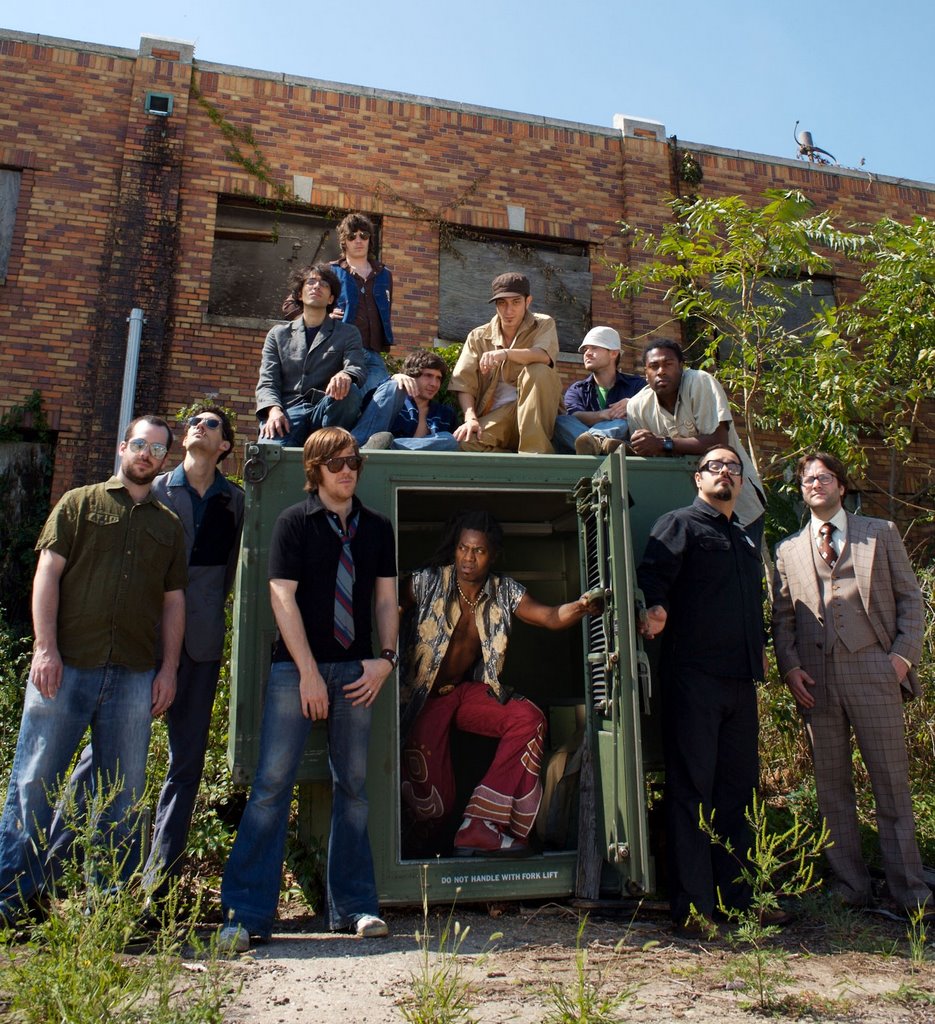
The Sunday Washington Post ran a nice article about Afrobeat this week, featuring Antibalas and Chopteeth (photo right, by Veronika Lukasova). The article is by the Post music critic Stephen Brookes, and it’s one of the few pieces out there that takes an overview of the US Afrobeat movement and tries to make some sense out of it.

Here are some excepts---the article starts out with a review of a recent Chopteeth performance at a rally to support the organizing drive of sanitation workers at Camden Yards, the Baltimore Orioles baseball stadium:

It's a gritty afternoon in a gritty parking lot in a gritty South Baltimore neighborhood, and the crowd is starting to fade. For the past five hours at this human rights rally, poets and rappers have been taking the stage to one-up one another's outrage, and now even the most anguished cries -- "the beast of the United States is eating wherever it wants!" -- are met with little more than polite nods. The sky's getting dark, the slogans are getting tired, and you can see people thinking that the struggle for justice should maybe just take the night off.

Then a new band takes the stage -- and suddenly a driving pulse erupts, powerful and irresistible. It's unlike anything else at the rally that day… This music has the drive of 1970s funk, the subtle rhythms of Yoruba tribal music, the fire of Ghanaian highlife. And when the five-piece horn section kicks in, driving the energy higher, everybody -- everybody -- starts dancing.

"We're here tonight to see people get active!" shouts the band's leader, pumping a fist in the air. "Otherwise, it's all over!"

The music is Afrobeat -- a fiery brand of political dance music pioneered in the 1970s by the Nigerian activist Fela Kuti -- and the group is Chopteeth, a 14-piece big band that's part of an Afrobeat revival across the United States. Thirty years ago, Afrobeat was the most important new music in Africa, fusing James Brown-style funk, African rhythms and urgent messages of political confrontation. But it never became an international phenomenon like reggae, and nearly vanished a decade ago when Kuti died.

Over the past few years, though, this profoundly African music has found a new home -- in America.
Martin Perna of Antibalas (photo below) also provided an interview for the Post article, adding a perspective on Afrobeat and its message:


"Afrobeat was a way for me to merge my political convictions with my convictions as a musician. It's inherently a music of resistance and a music of struggle, and if you're going to reach people with any sort of message, you've got to put it to a beat."

Reinventing Afrobeat may be the key to its survival, its proponents say. The music is unlikely ever to enter the mainstream -- "there's too much stuff in Afrobeat for the market to dumb down," says Perna -- but if it's going to take root in American soil, it needs to adapt. The new players are hardly African firebrands. They tend to be American, white and mostly suburban. The music even seems to be turning into new, hybridized genre -- call it American Afrobeat -- with an agenda of its own.

"Most of the groups doing Afrobeat are either multicultural or predominantly white," says Perna, whose own background is Hispanic. "How they address the privileges they enjoy -- male privilege, class privilege, skin color privileges -- will give American Afrobeat its depth; looking within themselves, rather than just pointing. Anybody can point a finger at George Bush, or the Iraq war, or police brutality, and write a song about it. But the real depth comes from examining these other systems of privilege. And we try to do that in our music."
It continues to amaze me how Afrobeat musicians in the US and other parts of the world are adapting Fela’s music in new ways to reflect their own musical interests and their own message. The music is flourishing all over the world, and seems to only be growing in popularity and attention. Keep it going!

Friday, July 20, 2007

The "Son" And The "Father"

By Marc Bruner

It just doesn't get any better than this - sitting in the open air under the beautiful California sky watching a fantastic double-bill of African music, with Vieux Farka Toure opening for Toumani Diabate. What an exciting and memorable show!

Vieux, the immensely talented son of the late Malian musical giant Ali Farka Toure, put on a mesmerizing performance of electric guitar-based blues and African rock. African music lovers delighted in the 2006 release of Vieux's excellent debut album, but as Banning Eyre (senior editor of afropop.org) explains, "as great as the recording is, it in no way prepared me for the charisma, chops, and overall showmanship of the young man himself."

All Music Guide explains, Vieux's music "is such a triumph in every way that the question isn't whether he will carry on the legacy, but rather just how much further he will take it." As a special treat, the legendary guitarist Mama Sissoko was part of Vieux's band, adding wisdom and experience (and another wickedly talented guitar player) to Vieux's youthful exuberance.

Toumani Diabate and his band were no less impressive, blending tradition and modernity in a captivating big band sound. Toumani is not only one of the world's very greatest kora players, but is also a tireless innovator and an extremely entertaining showman. At one point, he gave a kora lesson to the audience, showing how to play the bassline and melody while improvising, all at the same time.

When I first heard a CD of Toumani playing the kora, I wrongly thought it was several different musicians, not figuring it was just one lone master doing three things at once. And with his 10 other supremely talented band-members, Toumani created a veritable wall of sounds and rythms that had the crowd dancing and smiling ear to ear.

The pairing of these two great artists is especially fitting, given Toumani's groundbreaking collaboration with Vieux's father Ali before his death, as well as Toumani's contributions to Vieux's own album. Toumani even referred to Vieux as his own "son," who was continuing Mali's musical traditions and innovations into the next generation. Apparently, Ali Farka
Toure didn't even want his son Vieux to be a musician, and it was none other than Toumani Diabate who persuaded Ali otherwise. I'm sure thankful for that.

Sunday, July 01, 2007

Toubab Krewe's Unique Blend

By Marc Bruner

Toubab Krewe's debut album, an invigorating and innovative mix of West African and down-home American music, certainly took me by surprise. Their live performance Saturday night in San Francisco was even more of an eye (and ear) opener. At times hard-driving and frenetic, at times silky and ethereal, the band is incredibly tight, extremely talented and loads of fun.

Members of the band, which hails from Asheville, North Carolina, studied music extensively in West Africa and the result is a thrilling blend of musical styles that uses traditional Malian instruments like the kora and kamelen n'goni in new and exciting ways.

NPR explains: "Toubab Krewe's sound combines traditional West African rhythms and instruments with classic Southern rock, hip-hop, reggae, country and Latin sounds for a unique listening experience." On stage, they infuse this rich musical mix with unparalleled energy and passion, for a live show that leaves you speechless, but keeps your feet moving throughout.

I heard it from a good source that Chopteeth recently opened for Toubab Krewe in Baltimore. I wish I could have seen that one. Definitely check out Toubab Krewe's debut album here.

Sunday, June 24, 2007

Refugee All-Stars and Aphrodesia Bring Message of Peace


Don't miss Sierra Leone's Refugee All-Stars, who are currently touring after the 2006 release of their inspiring first CD "Living Like a Refugee." I recently saw them in San Francisco, and the show was positively electric.

Aphrodesia, a 10+ piece Bay Area band, opened with a great set of funky music, blending Afrobeat, highlife and funk with a colorful and delightfully irreverent stage presence. Their music is politically charged, but also incredibly fun and entertaining, and everyone was dancing. I couldn't help myself and just had to pick up one of their CDs.

By the time the Refugee All-Stars hit the stage, the place was packed and ready to burst. The All-Stars, who are the subject of a remarkable documentary film airing on public television, fled Sierra Leone during the country's decade-long civil war and formed a band in a refugee camp in neighboring Guinea. They sing about the atrocities of war and the brutal violence of oppression, but their reggae-inspired music is unswervingly uplifting, transforming unspeakable horrors into gorgeous, soothing melodies. Especially in these difficult times, their simple onstage message to the crowd should not go unnoticed: "Peace to Sierra Leone, peace to Africa, peace to the United States, peace for everyone."

More on the Refugee All-Stars here.

Monday, December 25, 2006

Mr. Dynamite Dead at 73

By Robert Fox

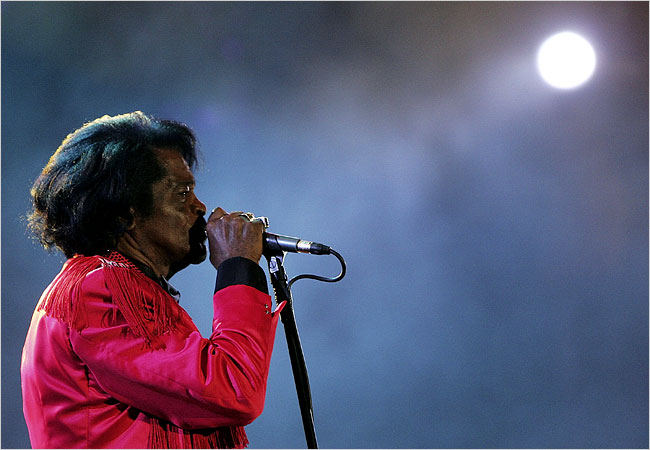
Sad news on Christmas morning: James Brown is dead. It's hard to put into words the impact JB had on 20th Century music. He nearly singlehandedly invented not one but two major musical forms, Soul and Funk, and charted the course for countless artists despite his many quirks and periods of erratic behavior. While it's been some time since The Godfather of Soul was at peak form, his most vital music remains as fresh and innovative as ever. Jon Pareles in today's New York Times concisely summarizes the career and earth-shattering power of James Brown--the first of many eulogies and rememberances that are sure to come:
James Brown, the ‘Godfather of Soul’, Dies at 73
By JON PARELES
The New York Times

James Brown, the singer, songwriter, bandleader and dancer, who indelibly transformed 20th-century music, died today at Emory Crawford Long Hospital in Atlanta, where he been admitted on Saturday for pneumonia, news services said. He was 73 years old and had lived in Beech Island, S.C., near the Georgia border.

His agent, Frank Copsidas, told The Associated Press Mr. Brown died of congestive heart failure.

Over a career that lasted more than 50 years, Mr. Brown called himself "the hardest working man in show business," "Mr. Dynamite," "Soul Brother No. 1," "the Minister of Super Heavy Funk" and "the Godfather of Soul," and he was all of those and more.
Mr. Brown's music was sweaty and complex, disciplined and wild, lusty and socially conscious. Beyond his dozens of hits, Mr. Brown forged an entire musical idiom that is now a foundation of pop worldwide.

"I taught them everything they know, but not everything I know," he wrote in an autobiography.

The funk he introduced in his 1965 hit, "Papa's Got a Brand New Bag," was both deeply rooted in Africa and thoroughly American. It found the percussive side of every instrument and meshed sharply syncopated patterns into kinetic polyrhythms that simply made people dance.

His innovations reverberated through the soul and rhythm-and-blues of the 1970s and the hip-hop of the next three decades. The beat of his instrumental "Funky Drummer" may well be the most widely sampled rhythm in hip-hop.

Mr. Brown's stage moves -- the spins, the quick shuffles, the knee-drops, the splits -- were imitated by performers who tried to match his stamina, from Mick Jagger to Michael Jackson, and were admired by the many more who could not.

And especially during the 1960s, Mr. Brown was a political force; his 1968 song, "Say It Loud -- I'm Black and I'm Proud," changed America's racial vocabulary.

He led a turbulent life, serving prison time as both a teenager and an adult. He was a taskmaster who fined his band members and staff for any errors, and he was an entrepreneur who in 1999 netted $30 million for bonds based on future royalties.

Mr. Brown was married four times, most recently to Tomi Rae Hynie, one of his backup singers. The couple had a child, James Jr.

Living up to his nickname, Mr. Brown performed constantly -- as much as 51 weeks a year in his prime. He was scheduled for a string of performances in the New York area this coming week, including a New Year's Eve show at B.B. King's nightclub in New York.

Mr. Brown's last public appearance was three days ago, when he joined volunteers in Atlanta for a toy giveaway he organized each Christmas.
Long Live James Brown!

Tuesday, November 28, 2006

Antibalas Signs With Anti Records

By Robert Fox

Brooklyn’s neo-Afrobeat pioneers Antibalas announced a recording deal last week with the acclaimed independent Anti Records. Anti’s roster includes some of the most innovative and influential artists currently recording, including The Sierra Leone Refugee All-Stars, Michael Franti & Spearhead, The Coup, Tom Waits, Merle Haggard, Solomon Burke, Blackalicious and many others.

The Anti Records website announced that Antibalas is planning a March 2007 release, titled “Security,” which will “explore and unleash new sonic elements.” Anti Records adds that:
the new disc and label deal illustrate Antibalas’ penchant for taking chances, building on its acclaimed live shows, back catalog and genre crossing collaborations… Always looking to push their unique sound further, however, Antibalas recently entered the studio to record their fourth album with much-heralded musician/producer John McEntire…The seven new original compositions presented here illustrate perhaps a darker, more dynamic approach that’s guaranteed to shock and dazzle new and old fans alike. This is music that was made to linger long after the party’s over.
According to Anti, the track list includes the following titles:
01. Beaten Metal
02. Fillibuster XXX
03. Sanctuary
04. Hilo
05. War Hero
06. Ice
07. AGE
Antibalas just keeps getting better and better as the years progress, and I’m very much looking forward to hearing the new recording. Their signing with Anti represents another step forward for the Afrobeat Rennaissance that continues to build.

Sunday, November 12, 2006

The Ohio Players Kick Your Ass

By Robert Fox

Oh Wow!--check out this priceless clip of The Ohio Players doing "Fire" for live television in Germany, circa 1974. Are these guys supermen or what? Unbelievable musicianship and style, hailing from Dayton, Ohio, USA. The German studio TV crowd doesn't seem to know what to think! Note that the fire engine light effect stops after the intro--just keep watching for an unparalleled heavy-duty groove: