News, reviews and commentary on afrobeat and related music from Africa, The Caribbean and The Americas
Showing posts with label Fela Kuti. Show all posts

Sunday, February 26, 2012

Fela Soul

By Robert Fox

Fun recent mashup of Fela and classic hip hop innovators De La Soul by producer Amerigo Gazaway of Gummy Soul, who describes the project as follows:
What do you get when you put together afrobeat legend Fela Kuti and rap pioneers De La Soul? You get Fela Soul, a musical tapestry created by Gummy Soul artist Amerigo Gazaway. More than just a clever title, Fela Soul is an 8-track, 33 minute journey into the world of afrobeat rhythms, funky horn riffs,  and classic hip-hop gems. Using dozens of  hand-picked samples from the Nigerian instrumentalist and political figure Fela Kuti, and 8 carefully-chosen acapellas from the Native Tongue rap trio De La Soul, Amerigo seamlessly intertwines the two into something completely new and original.
NPR singled it out as one of the best recordings of 2011 from the independnt music publishing site Bandcamp:
Fela Soul is the sort of mash-up album that never gets tired. The concept is fresh and simple: Take the music of Afrobeat legend Fela Kuti and marry it with the raps of De La Soul. Fela Soul is the work of Gummy Soul producer Amerigo Gazaway, who makes his ingredients sound as if they were born to be together. (There's also an instrumental version of the album that you can also download for free.) Nashville's Gummy Soul, a boutique soul and hip-hop label, was founded by Walter Clark and started as a radio show on Vanderbilt's WRVU.
All the tracks are available for legal streaming and downloading along with liner notes from the Gummy Soul Bandcamp site. Enjoy:


There's also a cool video to accompany the recordings:


Hat tip to Marc Gabriel Amigone of the always up-to-date Afrobeat Blog for the heads up.  

Monday, February 21, 2011

Best Fela Video: Live in Berlin 1978 DVD


by David McDavitt

Surfacing mysteriously after over 30 years, the video footage of Fela and African 70’s set at the Berlin Jazz Festival (Berliner Jazztage) in 1978 is a true gift to lovers of Fela and Afrobeat, marking the best quality video/audio and musical performance of Fela to date. Seek it on Youtube if you must, but true fans will want to obtain a DVD copy to witness this event in its full splendor uncompressed, large, and with full sonic spectrum (hook this puppy through your sound system). Plus you will see the songs unbroken, with Fela’s informative introductions:

DVD and double CD set:
Fela Kuti, Anthology vol.2 (2CD, plus DVD) , Wrasse 2010
**Import (Europe)- make sure your TV can play PAL


1978 was a year full of historically significant events in the turbulent life of Fela Anikulapo Kuti. Fela was not performing locally, the Nigerian government had banned Fela shows for a year, and neighboring Ghana kicked him out after protestors adopted Fela’s “Zombie” in anti-government protests.

February, in anti-colonial cultural protest, he married 27 wives (his “Queens”) in Lagos. He and his republic staged a 78-day sit-in protest in the Decca Record company Lagos headquarters for breach of contract and royalty disagreements (Fela’s show in Berlin is the only reason they left). In April, Fela’s mother died of injuries she sustained during a government raid on Fela’s Kalakuta compound.

In November (or September according to some sources), Fela & Afrika 70 headlined the Berlin Jazz Festival, while back home in Nigeria, government forces demolished the Kalakuta compound. Shortly thereafter, Afrika 70 disbanded, after Fela’s longtime musical director/drummer Tony Allen quit, reportedly due to pay, autonomy, and respect issues (for example, Fela decided to use the Berlin Jazz money to fund his presidential campaign). Fela’s baritone saxophonist, Lenkan Animashaun (a.k.a. Baba Ani) assumed the duties of musical director of Fela's new Egypt 80 band.

Berlin Jazz 1978 was a landmark concert for Fela: a rare, high-quality, professionally recorded document of Afrika 70’s final show! The venue is in the round, and although there are few camera angles, close-ups and smart democratic focus on most band members is satisfying (though Allen is not covered quite as much as his importance commands). Songs are true Afrobeat length (approximately 15 minutes each). Solos are as strong as ever, this is Afrika 70 at their apex.

Musically, the band is tight, vocals are solidly accurate, and the groove is a stunning demonstration of the highest level of musicianship, control, and stage presence. The band is animated, engaging, and amusing (guitarists Kologbo & Shegun, and the percussionist Abayomi brothers are particularly entertaining). Dynamics are extreme and hits are thrillingly precise. The polyrhythmic percussion propels with bubbling tension and release, and contains the sonic interest of woody melodic gbedu (akuba).
In light of the band's brilliance and infectious energy, it is puzzling and vexing that the live audience does not react much. They do not stand, nor dance, mostly sitting watching, stroking their beards, exclaiming, "hmmm, indeed." Odd.

The video and audio quality is the best I have ever seen for a Fela concert. The mix is remarkable for the era and enormity of the band. The video is crisp and well lit, with white stage lights always on. Not particularly mood-inducing, but perfect to witness Afrika 70's band members playing, who are too often buried in the murky darkness. The band is perfectly tailored in bright yellow, with the chorus members donning complimentary purple. Fela is stunning in a yellow/dark blue brocaded jumpsuit.

Tony Allen plays an uncharacteristically large single-headed Rogers drum set, with dark Evans Hydraulic drumheads.


Quincy Joppes sums it up in his introduction: "We present to you today, the greatest thing that ever came out of Africa... Fela and the Afrika 70... an experience of real African music...you will see something very original politically, religiously, and musically.”


He introduces the members of Afrika 70:

Afrika 70 Band Personnel, 1978:
Fela Kuti- Hammond Organ/ percussion/ vocals
Tony Allen- Musical Director/Drum set
Lenkan Animashaun (Baba Ani)- Baritone Sax
Christopher Uwaifor- Tenor Sax
Ogene Kologbo- Tenor Guitar
Shegun (Leke Benson?)- Rhythm Guitar
Oye Shobowale- 1st Trumpet
Tunde (Baba Tunde) Williams- Trumpet.
Franco Aboddy- Bass Guitar
Henry “Ojo” Kofi- 1st Conga (Gbede)
Shina Abiodun- 2nd Conga
Addo Nettey- 3rd Conga
Ayola Abayomi- Sticks/Claves
Isaac Abayomi- Shekere

Chorus (unintroduced, but may include):
Bernadette Oghomienor- Chorus
Tejumade Adebiyi- Chorus
Sade Shehindemi- Chorus
Regina Osundor- Chorus
Felicia Idonije- Chorus
Suru Eriomila- Chorus


The songs on the Fela live in Berlin (1978) DVD :


1. V.I.P (Vagabonds In Power)
Fela introduces V.I.P., “Look at me as something new, something you have never seen before...99.9% of the information you get about Africa in wrong...V.I.P.means ‘Very Important Personality’...but you see, when these VIP get too rich, they do not want to see the ordinary man on the street who is poor.” Fela chastises audience members for talking while he is introducing the song.

2. Power Show
Introduction- “I am going to stand for presidency of my country next year... Somebody ask me, ‘how can a musician be a president’, and I ask him how can a lawyer be a politician?... The big man, like to use power to strike you down... the African concept of music, where jazz originated...” This performance is quite a rollicking rock version.

3. Pansa Pansa
Introduction- “You see when you are a revolutionary and you talk the truth... people will come and slap you down... then you talk again, they put you in jail... and when you are very strong, and you talk again, they may kill you, they may even burn your house down.... African people are afraid for life... they say, ‘do not talk again’.... but they no hear at all, they going to hear Pansa Pansa (more and more...) because the truth can never die”. Pansa Pansa is a wicked fast Afrobeat groove. The bass guitar is a little low in the mix here- crank your bass settings for maximum funk. Watch for the percussionist helping the guitarist adjust his settings mid song! Pansa Pansa recounts some of Fela’s revolutionary hits, then directs some audience participation. Look for Fela’s organ solo surrounded by his percussionists and guitarists striking photogenic poses around him.

4. Cross Examination of the African Colonial Soldier
Cross Examination imagines putting the "African colonial soldier" on trial (Nkruma as judge, Fela as prosecutor, JK Braimah as defense).

**Cross Examination contains extended masterful solo work by drummer Tony Allen- leading Fela’s wives/ dancers in provocative displays!

If you purchase the DVD, you get the bonus of 2 CD’s or Fela’s best:


CD Track list


CD1
1. Expensive Shit
2. He Miss Road
3. Everything Scatter
4. Ikoyi Blindness
5. Kalakuta Show
6. Na Poi (1975 Version)

CD2
1. Colonial Mentality
2. Zombie
3. Unknown Soldier
4. Coffin For Head Of State (Part 2)
5. Africa Centre Of The World

Get it!


Check out The Shrine's breakdown of Fela's DVD releases! (news, bios, shows...)

Thursday, June 17, 2010

FELA on Broadway wins 3 Tony Awards


FELA on Broadway no get enemy. In fact it has the enthusiastic support of the popular masses, and now official recognition from the Tony Awards.

Best Choreography: Bill T. Jones
Best Costume Design: Marina Draghici
Best Sound Design: Robert Kaplowitz

Everybody say, "Yeah Yeah!"

Monday, May 24, 2010

“FELA! on Broadway” Original Cast Recording


The ultimate Fela tribute band (a.k.a. “FELA!” on Broadway) will release a CD June 8, 2010. Performed by members of Antibalas afrobeat band, with Sierra Leone’s Sahr Ngaujah on lead vocals this album is sure to be an afrobeat classic. Broadwayworld.com rates the forthcoming original cast recording of the afrobeat musical 9.5 out of 10 stars. Produced by Rob Sher (Follies and Gypsy), the Grammy nominated soundtrack is a combination of music and monologue.

TRACKS:
1. Everything Scatter
2. Yellow Fever
3. Trouble Sleep
4. Teacher Don't Teach Me Nonsense
5. Lover
6. Upside Down
7. Expensive Shit
8. I. T. T. / Pipeline
9. Water Get no Enemy / Egbe Mi O
10. Shuttering and Shmiling
11. Zombie
12. Na Poi
13. Sorrow and Tears and Blood
14. Dance of the Orishas
15. Shine
16. Coffin Head of State

BAND:
· Stuart Bogie—Tenor Saxophone
· Dylan Fusillo—Percussion
· Greg Gonzalez—Drums
· Alex Harding—Baritone Saxophone
· Jordan McLean—Trumpet
· Oren Bloedow—Guitar
· Ricardo Quinones—Guitar
· Yoshihiro Takemasa—Percussion
· Jeremy Wilms—Bass & Keys

VOCALS:
Sahr Ngaujah as Fela
Lilias White as Funmalayo,
Saycon Sengbloh as Sandra Izadore

Arrangements by Aaron Johnson and Antibalas.

Wednesday, February 24, 2010

Steve McQueen Fela Film in Production


By David McDavitt

Whoever thought theater would be the savior of Afrobeat music? 100-plus afrobeat bands have been pounding away in relative obscurity for the last 15 years or so, delighting only the privileged few with the secret knowledge of Baba Kuti’s unique groove. Then along comes the powerful Broadway play, “Fela!” attracting an impressive pop following and critical acclaim, educating thousands about Afrobeat and “Felasophy.” Awesome. It’s powerful when your girlfriend’s 64 year old mother asks you to borrow some Fela CD’s.

No doubt in great thanks to “Fela!” on Broadway’s success, now Afrobeat fans will be treated to another miracle, a Fela Hollywood film!

Focus Features has hired British director Steve McQueen (“Hunger”) to direct, ad co-write the script with the award-winning, Nigeria-born playwright Biyi Bandele (adaptation of Chinua Achebe’s, “Things Fall Apart”/ Shakespeare Theater Co.).

"Fela might be the most globally influential pop artist outside the Beatles in the last 50 years," Focus Features’ James Schamus told Variety.

Everybody say, “yeah yeah!”

Sunday, November 22, 2009

Fela Musical Moves to Broadway

By Robert Fox

Great review of Bill T. Jones's Broadway musical "Fela!" in today's New York Times.

I know that's an unexpected combination of words in a single sentence. However the critically-acclaimed show features serious music performed and arranged by key members of Brooklyn's Antibalas, and it provides a new platform to expand Fela's message and tell his story. This week the show moved to a major Broadway venue--the Eugene O’Neill Theater--following a highly successful Off-Broadway run. David McDavitt wrote a very positive review of the performance last year on this blog.

The New York Times piece gives a valuable stamp of approval to the show (Broadway shows are known to close immediately after a negative review in the Times). Here are some higlights:
Fela who? On Broadway?

Those are basic questions that “Fela!” faces when it opens on Monday. The show has moved from a widely praised Off Broadway production, last year at 37 Arts, to the larger and more mainstream realm of the Broadway musical — from 299 seats to 1,050. Amid theaters filled with more recognizable fare — movie adaptations, revivals, jukebox musicals — “Fela!” seems downright quixotic. Although the music that Fela invented, Afrobeat, and the central events of “Fela!” are familiar to Africans, in the United States Fela (as Kuti is usually called) is largely unknown except by African-music devotees and fans of political music.
...
The goal “Fela!” has set for itself is to be true to his music and his impact while reaching a Broadway musical audience. It is, inevitably, a translation, but one governed more by respect and ambition than by show-business routine. “Fela!” juggles the conflicting demands of Mr. Jones’s own artistic leanings — in a celebrated career that has often pondered history, race and sexuality — and the commercial imperatives of Broadway, where theatergoers’ idea of African music might begin and end with “The Lion King.”
...
“Fela!” shakes up its environment, making a Broadway theater look like a club.
The chronology of the show, set in 1978 but including events from the 1980s isn’t fully accurate, Mr. Jones allowed. Like Fela it prefers the mythic to the mundane and presents its story not through linear narrative but in songs, explosive dances, recollections and flashbacks loosely woven through a performance that Fela gave at the Shrine, his club in Lagos, Nigeria’s capital. It relies on the simmering beat of his music and the indefatigable dancing of an ensemble that regularly spills offstage and into the audience.
The article also includes a nice summary of why Afrobeat inspires so many:
In Africa, Fela, who died at 58 of complications from AIDS, is a figure to rival Bob Marley as both a musical innovator and a symbol of resistance. Afrobeat, the style he forged in the early ’70s, combined African rhythms and messages with the jazz and funk that Fela absorbed during his education in Britain and the United States. Ghanaian highlife, Nigerian Yoruba rhythms, Afro-Cuban mambos, James Brown, John Coltrane, Nina Simone and, yes, Frank Sinatra all flowed into his music, which sounds exactly like none of them.

Afrobeat is insinuating but hard-headed, with stubbornness encoded in its sound and its lyrics. Its grooves are unhurried and hypnotic, with guitar, bass and drums locked into repetitive patterns while voices and horns leap freely. On Fela’s albums songs stretch 10 to 20 minutes, in long, tension-and-release forms. Each track is an excursion through verses, choruses, jagged horn-section lines, call-and-response vocals with Fela’s backup singers and dancers (who were his wives), individual solos and bruising full-band attacks.

It’s music of steadfastness and endurance, of uncompromising determination. It’s also, of course, dance music, made for long nights in clubs. Within the grooves Fela’s lyrics denounce corruption and injustice, call for African values and challenge authority.
Check out these cool video and music samples from the show (and dig the Halliburton reference for a reminder of how some things never seem to change).

It's great to see Antibalas getting the credit they deserve for their superb musicianship and vision. The band is hosting a residency at the Knitting Factory in Brooklyn over the next few weeks for those lucky enough to get tickets to see them in their true element.


PS--There will be a special performance of the show on December 10th to support Amnesty International's Global Write-a-Thon as part of worldwide Human Rights Day. Use the code FEL4AMS to receive discounted tickets for the show that day. Amnesty International's prisoner of conscience campaign in the 1970's was instrumental in freeing Fela from prison and torture in Nigeria. Thanks to Nadine Bloch for the heads up on this opportunity to do the right thing!

Tuesday, August 26, 2008

FELA ! A New Musical

By David McDavitt


Fela on Broadway? Sounds like a disaster, right? I entered the theater fearing the worst, “Fela, Get Your Gun,” or “West Side Story, Lagos.” Fortunately what unfolded instead was a gritty, hyper-realistic biography of Fela Kuti told in an interview style, bejeweled with Fela’s own afrobeat music! Let’s break this masterpiece down!

Written by Jim Lewis and Bill T. Jones, the story relies heavily upon the best source on Fela: the transcribed interviews by Carlos Moore, “Fela Fela This Bitch of a Life.” Much of the story is biographical FELA 101, including his revolutionary civil rights ideologies, attacks suffered by the Nigerian government, relationship with his activist mother, and development of a novel musical genre, “afrobeat.” For those unfamiliar with Fela and Nigerian pidgin English, the producers thoughtfully include lyric subtitles, and a dictionary in the program. "Fela!" covers much ground, childhood to 1980-ish. Included in the play are some absolute gems of Fela trivia, indicating some serious research. Even I, a pretty diehard Fela fan, learned new facts! Also impressive was a section that deconstructed and then reconstructed “afrobeat” music, describing and demonstrating the sources and evolution of this fusion music in narrative form. Crucial.

The actors are phenomenal! Fela is brilliantly portrayed by Sierra Leone’s Sahr Ngaujah. It is obvious Sahr engaged in considerable scrutiny of the scant available Fela interviews and performances, as he has mastered Fela’s sly charm, fiery tirades, speech patterns and movements. And what isn’t Fela is real West African, filling in the gaps with palpable authenticity. There were a few moments when I found myself more thrilled than normally play-worthy, as if I was witnessing Fela himself at the Shrine nightclub in Lagos, Nigeria! The “Expensive Shit” scene was especially eerily Fela-esque.

Fela’s “Queens” were impressively portrayed by an international ensemble from Haiti, Zimbabwe, Central African Republic, the Netherlands, and the USA. Each conveyed an appropriate air of fierce pride & rebellious Lagos ghetto refinement. Character commitment even carried over to the way they looked at audience members as the queens passed through the aisles- a nod of solidarity to fellow women of African descent, a disdainful glance at oyinbo. The queens’ singing was dead-on, perfectly capturing the haunting shrill lax unison of Fela’s backing vocals.

Their African dancing was expertly choreographed by Bill T. Jones, and masterfully executed. It was so authentically African as to be absolutely natural and transparent.

The music was perfect, performed by members of Antibalas and Akoya afrobeat bands, as well as NYC mercenaries. The band is on stage and visible throughout the performance, lending a “live at the Shrine” feel to the performance. A brilliant decision to use a real afrobeat band! It was lovely to hear them play some Fela hits often avoided by bands because they are so well known. Like a real Fela performance, the band played long before Fela himself appeared (while the audience entered). Though out of chronological order, themed Fela tunes named and punctuated the scenes. And some obscure cuts- not only greatest hits! As the band dropped the first song, the wicked grooved, seldom heard “Everything Scatter,” the hair stood on the back of our necks, and we the audience knew we were in for some serious funking.

ACT 1 Everything Scatter, Yellow Fever, Trouble Sleep, Teacher Don’t Teach Me Nonsense, Lover, Upside Down (with a Sandra Izsadore sound-alike Sparla Swa!), Expensive Shit, ITT/Pipeline.

ACT 2 Water No Get Enemy/Egbe Mi O, Shuffering and Shmiling, Zombie (great choreography), Na Poi, Sorrow Tears and Blood, Dance of the Orishas (trad. bata), Shine (by Johnson, McLean, Lewis), Coffin for Head of State


ANTIBALAS
Conductor/Tromb/Keys: Aaron Johnson
Director: Jordan McLean
Bass: Nick Movshon
Guitar: Marcos Garcia (wow!)
Tenor Sax: Stuart Bogie
Sticks/Shekere: Dylan Fusillo (displaying impressive discipline)

AKOYA
Congas: Yoshihiro Takemasa (yosh!)

INDEPENDENT
Guitar/Keys: Jeremy Wilms (yeah brother)
Drums: Greg Gonzales (most accurate "Water" groove I've heard!)
Bari Sax: Alex Harding (ya mon!)

While all band members are masters of Afrobeat, verbatim sax solos by Antibalas’ Stuart Bogie stole the show despite Fela’s (Sahr’s) lip-synching the sax solos on stage.

Some songs were sung a-cappella to haunting effect (like “Shuffering and Shmiling,” and “Trouble Sleep”). Other songs were spoken as narrative, like parts of “Sorrow Tears, and Blood.” Musically, the only detraction I noticed, was the altering of song lyrics to “translate” them for non-Fela fans. The new lyrics lacked the poetic power and cadence of Fela’s originals. Given the projected subtitles of lyrics, I wish they had “translated” them via projection, and left the songs untouched. The Anglicized lyrics were silly, distracting, and disrupted the rhythm of the vocals. "Coffin for Head of State” and “Trouble Sleep” suffered the most for lyric tampering.

Costuming was accurate down to the smallest details. Those of the queens (Act 1) were especially noteworthy, evoking specific wives of Fela in splendorous stage attire.

The performance was enhanced with projected real and simulated video footage of Fela, the police, soldiers, Lagos, Fela’s mother, etc. It added a captivating dimension. Set change was achieved via sophisticated manipulation of lighting and paint. The sets also employed black light paint (invisible otherwise) that made the set burst into a mystical veve mosaic for a stunning vodou scene. One moment we're in the ruby atmopsphere of the Shrine in Lagos, the next we're dancing with Shango in the magical realm of the Ifa.

The night ended with a generous encore of “Gentleman” with none other than Bill T. Jones dancing up a storm wearing only gray suit pants (very Lagos).

Bottom line, this musical sets a new standard for realism and power. This play is a vehicle for the ultimate Fela tribute band, and likely as close to a live Fela show possible. It would be a crime for "Fela!" not to win a Tony.

Friday, May 23, 2008

Keeping It In The Family

By Kenneth Eaton

Fela Kuti is praised the world over as the father of Afrobeat. His virtuosic approach to songwriting and legendary stage presence still provide inspiration to countless musicians and bandleaders. Fela’s two sons, Femi and Seun, are continuing in their father’s footsteps and blazing new trails in Afrobeat. Last month, Seun launched a world tour and released his first CD--you're definitely going to want to hear it. Be sure to check out this excellent new article in this month’s issue of The Walrus about Fela and his sons. Here's a clip about Fela from the article:

When twenty-five-year-old Seun Kuti of Nigeria took the stage for a showcase concert in Seville, Spain, last October, it was as if a ghost had entered the hall. Seun was fronting his late father’s band, Egypt 80, orchestra sized and iconic in the minds of some 2,000 world music professionals gathered for the annual womex trade fair. This was Fela Kuti’s legendary Afrobeat sound as few have heard it since the patriarch died of aids in 1997. The Egypt 80 brass section sounded dense and primal, blaring out passages from Fela’s epic composition “Colonial Mentality” over thick layers of interlocked guitars and keyboards, muscular bass, bubbling percussion, and — an Afrobeat signature — high hat sizzling like bacon in a pan. At centre stage, young fearlessly appropriated his father’s trademarks: the tight pants, the bare chest, the occasional dalliance with a saxophone, the rough, taunting, half-rapped vocals that morphed from playfulness to outrage, and the quirky stage moves — in Seun’s case, wildly elastic, almost contortionist. We could have been peering through a time tunnel at the young Fela himself.

Of course, when Fela Kuti was in his twenties he was an unknown. In 1963, he had been studying at the Trinity College of Music in London, and was returning to a hopeful, newly independent Nigeria with his head full of soul music, jazz, and “highlife” — West African boogie. Fela’s early attempts to fuse these genres were innovative but not especially well received in Lagos, where audiences preferred their highlife free of jazz complexity. It was only some seven years later, when, after processing black power, free jazz, and James Brown, Fela created Africa 70 and the funky, irreverent sound we now know as Afrobeat emerged. By the mid-’70s, he was pioneering a new art form with his bold, often profane assaults on Nigeria’s
political class, which he portrayed as thieving and squandering billions in oil and other revenues while doing little to improve the lives of ordinary people. Fela’s songs lasted twenty minutes or more, with the maestro conducting his enormous brass section, pounding on a Fender Rhodes keyboard, blowing on his tenor sax, and, when he was good and ready, barking out pidgin English screeds the likes of which had never before crossed the lips of an educated Yoruba man. Songs like “Why Black Man Dey Suffer,” “Expensive Shit,” “No Bread,” “Up Side Down,” and especially “Zombie,” Fela’s lacerating parody of Nigerian soldiers, had no precedent in African music. Musicians were there to praise, to uplift, and entertain. This one seemed hell bent on destruction.
You can hear tracks from the new CD on the My Space page for Seun Kuti and Egypt 80.

A particularly exciting performance in the works is on July 6th in NYC’s Central Park for the Summerstage concert series--Seun Kuti will be playing with Afrika Bambaata (who has been credited more than anyone else as a driving force in the emergence of hip-hop), plus reggae hero U-Roy. Seeing these legends of music in one night will definitely be a memorable experience. For those in the Washington, DC area, Seun Kuti and Egypt 80 will be playing at The 9:30 Club on July 7th.

Banning Eyre has a great interview with Seun from 2007 on Afropop Worldwide. And--I hope you have room to dance near your computer--check out this spellbinding video of Seun Kuti and Egypt 80 while in Dakar in 2005, featuring the immortal Tony Allen on drums and Manu Dibango on sax. Wow!

Monday, October 15, 2007

What Would Fela Do?

By Robert Fox

Today is Fela's birthday, and he would have been 69 years old. What would he be singing about now?

No doubt he would include many of the same themes that he addressed during his lifetime: the ongoing exploitation of Africa in general and Nigeria in particular by the wealthy and powerful, from London to Lagos, Washington to Kinshasha; the sorrowful indifference of the governments in industrialized nations to the poverty, inequality and suffering their development models bring to much of the world; the madness of the war in Iraq; the unending massacres in Darfur and Congo.

I think Fela would certainly still be addressing the agonizing persistence of torture and inhumanity in prisons around the world, as a victim of military brutality himself. And I hope he would have eventually turned his immense charisma and musical power toward addressing AIDS prevention and education.

What kind of music would Fela be playing now? That's an interesting question. Given the changing trajectory of his music over the years, from jazz to highlife to funk to Afrobeat, I think it's safe to expect that he would have taken his music in new directions. The resurgence of Fela's popularity in recent years would presumably have given him a broader worldwide platform than ever.

Perhaps he would have moved to include hip-hop in his music, maybe adding a wider variety of collaborations, something along the lines of the Red Hot and Riot project? Maybe a step towards tighter grooves and melodies, e.g. Tony Allen's "Home Cooking?" Experimenting with remixes along the lines of Manu Chao or my new favorites from the neighborhood, the Fort Knox Five? Maybe Fela would have gone back to his roots in hard bop jazz and headed in the direction of current jazz-funk heros like Christian McBride or Galactic? Possibly he would have come to work more Latin influences into his music, like so many other West African musicians of his generation--think Ozomatli, Yerba Buena or Grupo Fantasma?

However, it's rare that popular music artists substantially change stylistic direction once they reach a certain age. It seems like many find a form that works for them artistically, musically and/or financially and they stick with it, although exceptions do stand out, such as John Coltrane, Miles Davis, John Zorn or Lou Reed, not to mention a more recent favorite of mine, P.J. Harvey.

But maybe Fela would have gone back to the old-school Afrobeat that he invented and no one has ever topped? So for Fela's birthday, check out the Birth of Afrobeat from this priceless live footage of Fela and Africa 70, from Ginger Baker's 1971 Africa documentary--any doubt who is in charge of this band?:


Wednesday, June 20, 2007

Fela Documentary Featured By Human Rights Watch

By Robert Fox

Check it out: the Human Rights Watch International Film Festival is featuring Dan Ollman's new documentary on Fela Kuti, entitled "Suffering and Smiling." The documentary will be shown four times this week at the Walter Reade Theatre and is presented in association with the always inspiring Film Aid International. Here's more from Human Rights Watch:

Focusing on the legendary African singer and activist Fela Anikulapo Kuti and his son Femi, Suffering and Smiling depicts the impact of their politically charged music. Following Nigeria's independence in 1960, Fela used his songs to speak out against the country's corrupt leaders. Since independence the military and political elite have enriched themselves by allowing Nigeria's oil and natural resources to be stripped by multinational corporations with little benefit to ordinary Nigerians. Fela gave voice to Nigeria's disenfranchised underclass and sang of a free and united Africa. Upon his death in 1997, Femi has continued his father's legacy. Equally passionate and charismatic, he sings about the dire situation in his country, asks why the world's most resource-rich continent has the poorest people, and struggles to maintain a vision of better days ahead for the common people of Nigeria.

SHOWTIMES: Wed June 20: 2PM
Fri June 22: 4
Sat June 23: 9
Sun June 24: 1:30

Running from June 15 to 28 at the Walter Reade Theater, the 18th edition of the Human Rights Watch International Film Festival features 21 films and three shorts from 17 countries and includes 16 New York premieres. Tickets for the 2007 Human Rights Watch International Film Festival are available at both the Walter Reade Theater box office (212)875-5600 and online at http://www.filmlinc.com/.
Fela fans and anyone who supports human rights struggles will definitely want to check this film out. Alternative Film Guide adds a highly postive review:

Dan Ollman’s atmospheric Suffering and Smiling highlights the situation in Nigeria. Lone voices cry out against the injustices suffered by the general population while the country’s rulers maintain a culture of corruption, self-gratification, and ruthless domination of the people they purport to serve. Suffering and Smiling takes an unusual approach to the problem, as the vitality of at least one segment of Nigeria’s cultural history is expressed in the film through the words of African singer and activist Fela Anikulapo Kuti, who started singing about Nigeria’s problems following the country’s independence in 1960, his son Femi, and their family...Suffering and Smiling also shows that many Nigerians are deeply concerned with the country’s sociopolitical situation, and are committed to bringing that issue out into the open regardless of the dangers involved. The film’s music is particularly effective. With its unique lyrics (that defy "classical" musical structure), the singers and their fellow musicians manage to express their strongest views on Nigeria’s political climate with unequivocal clarity.
Any AfroFunk Forum readers out there who can share a review of the film?

Tuesday, November 28, 2006

Red, Hot + Riot Live Concert Tribute to Fela

By Robert Fox

The Brooklyn Academy of Music (BAM) is hosting an historic live tribute to Fela Kuti on Friday, December 1st and Saturday, December 2nd. Scheduled to commemorate World AIDS Day on Dec 1st, the two shows will re-unite many of the musicians who participated in the groundbreaking Red, Hot and Riot musical benefit project in 2002.

Some of the top musicians in the world will be traveling to Brooklyn for the show, including Tony Allen, Amadou & Mariam, Cheikh Lo, dead prez, Keziah Jones, Les Nubians, Meshell Ndegeocello and Yerba Buena with Special Guest John Medeski. BAM is one of the premier cultural institutions in the United States, and it’s wonderful to see Fela’s music receving this type of high-level feature. (BAM is also close to my heart personally, as I lived a few blocks away in Brooklyn for more than 10 years).

The event is a benefit for the African Services Committee, as described on the BAM website:
With musical direction by Andres Levin, it's not only two nights of great music, but two nights for a vital cause. A portion of proceeds will benefit African Services Committee, an organization which promotes the health and self-sufficiency of New York City's African and Caribbean immigrant communities through the provision of HIV/AIDS care and support services.
BAM will also ferature a series of related concerts at BAM Café, starting tonight, Tues, Nov 28th with Wunmi and continuing Wed, Nov 29th with Emperor Adiche, Thurs, Nov 30th with Akoya Afrobeat Ensemble and Sat Dec 2nd with DJ Acidopholus.

On Saturday, December 2nd, BAM will also present four screenings of the new documentary film Fela! Fresh From Africa, which records Fela’s triumphant visit to New York following his release from prison.

And if that's not enough for you, on Friday night, December 1st, you can check out members of four acclaimed US Afrobeat bands joining forces in Brooklyn at the club Northsix for a major Fela-inspired all-night-throw-down jam. This show will also be a benefit for World AIDS Day, and will feature musicians from Chicago Afrobeat Project, Kokolo (NYC), Boston Afrobeat Society and Chopteeth (Washington, DC). The Northsix jam starts at midnight—don’t miss out!

It's a major week for Afrobeat fans everywhere, but especially those of you in the New York City area. Que Viva Fela Kuti!

Tuesday, October 24, 2006

Baba Ani: "Fela Still Appears To Me In My Dreams"

By Robert Fox

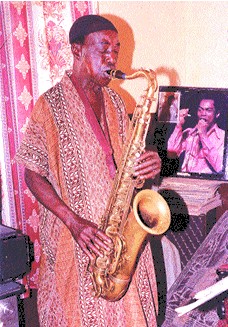
Lekan Animashaun, aka Baba Ani, baritone sax player and leader of Fela Kuti’s legendary Egypt 80 band, gave a revealing interview last week to Lagos’s The Daily Vanguard newspaper. Baba Ani was one of the original members of Fela’s musical universe, joining him to help form Koola Lobitos in 1965. He remained as a key force in the innovative horn section that powered Fela throughout the musical glory days the 1970s, and was also a leader of the Movement of The People, a political party founded by Fela.

In the extended interview, Baba Ani, who just turned 70, reflects on his three decades of playing music with Fela:

The Vanguard: How did you then meet Fela?

Baba Ani: I met him at NBC studios at Ikoyi (Nigerian Broadcasting Corporation). At that time when I was with the NBC band, we used to rehearse on Mondays, Wednesdays and Fridays, unless we were having a show, which was the procedure. I was there on one of the rehearsals and decided to go to the canteen during break and met Fela and introduced myself to him. Before then I had heard about him trying to form a highlife band, when he got back from London he was having a small group, a combo with Tony Allen on drums. So I walked up to him and explained what I heard about him concerning his plan to form a highlife band and explained to him the instrument I could play. He asked if I had my instrument with me and my response was in the affirmative. So, he gave me an appointment for four o’clock on Monday at his then Kalakuta Republic, 14A Agege Motor Road.

That same evening, I got home, carried my baritone and headed for Fela’s house. I met him with Benson Idonije who was producer at NBC, January 1965. He gave me a piece of paper on which he had written the baritone part. So, I set up my instrument and I went and read through it with my instrument and he said to Idonije; ‘ah! He has made it.’ That was how we started together...
Baba Ani was a skilled sight reader, but he explains how Fela wrote out horn parts for the musicians in the group, who came from a variety of musical backgrounds:

The Vanguard: Did Fela write his music, score the drums?

Baba Ani: He did, sometimes he uses his mouth to dictate the rhythm he wants, but initially he was writing. Even he was writing on music manuscript but when it got a stage he was writing on pieces of papers because he had reduced his music writing to tonic solfa instead of writing the note.

The Vanguard: Why did he do that?’

Baba Ani: Because at that time we were having problems with instrumentalists that couldn’t read music. To make it simpler for those who could not read notation on music manuscript, and were able to understand tonic solfa and that was why he reduced his music reading to tonic solfa on pieces of papers.
Baba Ani also describes the mistrust that some Nigerians had for Fela and his revolutionary message:

The Vanguard: How did your family take your association with Fela, the late nights, beating up of the band members (by the police and army)?

Baba Ani: It was battle royale because none of my family members supported my playing with Fela, even playing music because I remember when I was playing with Chris Ajilo at the Federal Palace Hotel, when I dressed up in the evening to go to the Federal Palace to play, some of our neighbours then would call my mother to say that I was a cult member and going for a cult meeting. A good number of my family members did not support it. Even the mother of my wife today for about three months before our marriage washed her hands off, saying that her daughter wasn’t going to marry Omonilu, but later she saw that the whole thing was becoming a reality so, she had no choice but to accept me and the ceremonies were held because I stood my ground like I still do today.
This month, Baba Ani was also honored for lifetime achievement by the Nigerian Committee for Relevant Art (CORA), part of the Nigerian Great Elders Forum, as described in The Sun newspaper (Lagos).

The late-70s Baba Ani solo albums Mr. Big Mouth and Low Profile (with Tunde Williams) were recently re-released, but their scarcity and high price reflects the collectors value and uniqueness of the music.

Wednesday, October 04, 2006

Felabration

By Robert Fox

On September 23rd, Fela fans in Lagos had the chance to participate in the annual Felabration, a celebration of the life and meaning on Fela Kuti at The New Afrika Shrine. Held the day after Fela’s birthday, the event drew large crowds to memorialize Fela and witness the relics of his manic vision. In life, Fela was raised to a near-deity status by fans worldwide, a status that has changed little since his death, as described in The Daily Sun of Lagos:

Die-hard fans and apostles of Afrobeat last Saturday besieged the New African shrine off-Agidingbi Road, Ikeja, for a the celebration of the late maestro, Olufela Anikulapo Kuti…
The narrow entrance, built purposely to check crowd influx gave way to a narrow but culturally designed passage. Walled by ropes that bore palm fronds, the route that led to the main auditorium took passers-by through series of Fela’s mementos. There were about three stops. Each stop, a genuine hut played host to personal effects of the Abami Eda himself. One of the huts for instance had all the sleeve album covers of Fela on display. There was also an array of his clothes and shoes suspended on the walls of the huts. Other objects that drew attention were the age-long saxophone, cigarettes, photographs, and the statues of Fela.

It’s no understatement that a first timer would scamper for dear life on entering the last hut. But for the water works, every other object there were fit for a shrine. And truly, there among the water fountain, busts, and other images of the deified Fela. Seated beside the god was a shrine priest, naked, save for the half-yard cloth appearing as a pant. His posture was harmless, only that the shrine make-up could arrest a novice’s courage. On the floor were broken kola nuts.

Two flat ceramic plates, one containing palm oil and the other salt, sat comfortably as he did at either edges of a bit raised concrete ground fencing the shrine. Huge even in his sitting position, the priest occasionally sprinkled the running water on the fixed Felas around him as if he had received a warning; "We must not be thirsty for a second". He never spoke all through the presence of this reporter….
Artists performing at Felabration included: Sound Sultan covering Fela’s “United Nations;” D’banj who did a remixed version of “Sorrow, Tears and Blood,” as well as Alariwo and Segun Adefila’s Crown. A concert festival scheduled for later this month at the New Shrine will feature South African reggae star Lucky Dube, who will headline “Afrika Unite for Fela-a showbiz re-union celebrating Fela” on October 14th.

Felabration organizer Tunde Oshnubosi, a.k.a. Laface, argues that “Fela is the most popular Nigerian in the world,” and he sees the annual event and concert series as a way to increase Fela’s profile within Nigeria and also to help develop the Nigerian tourism industry. As quoted in The Vanguard (Lagos):
All over the world, other countries celebrate their own icons, in grand style and on a yearly basis; Bob Marley and Elvis Presley. They build major tourist attractions around their icons. The time has come for us to do the same in Nigeria with Fela. We need to attract people from all over the world to Nigeria. In the name of Fela and building our tourism industry and making Lagos a major tourist haven. Nobody will do it for us, we shall have to achieve this ourselves--Fela like football unites Nigerians across religion and ethnic background.
If any readers have a first hand report on this year's Felabration, please send it to The AfroFunk Forum and we’ll post it!

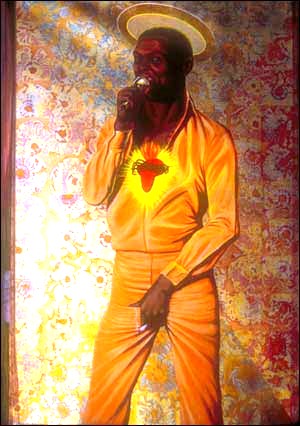
The painting included in this post is Barklay Hendrix's portrait of Fela from the 2003 exhibit Black President: The Art and Legacy of Fela Anikulapo-Kuti.

Thursday, September 28, 2006

Fela: "Subliminal, Dissident, Persuasive..."

By Robert Fox

There's a strong new essay about Fela Kuti currently featured on the homepage of the excellent Fly Global Culture website. The Fela Renaissance is clearly continuing to generate critical attention and reassessment. The article, by Nigerian poet Patrick Iberi, is a sympathetic and well-written portrait of Fela as revolutionary and musical rebel:
Fela Kuti as an artist embodied different things to different people. For the vast majority of Nigerians, he stood tall as a social crusader who championed the fight against oppression, government excess and corruption. To the
authorities, he was just a dissenter, a cannabis-smoking saxophonist who was to be vilified, hounded and imprisoned. To the rest of the world, he was more like the eccentric performer whose unyielding lyrics gave jazz a rebel face. Indeed, Fela's life as a maverick resonated in the genius of his art: Afro beat music so subliminal, so dissident and yet so persuasive.
The political challenges Fela faced in his day remain the same problems we face today in the US and in many places--certainly adding to the continuing relevance of his cultural and political message. As Iberi points out:
Fela's frown on Western imperialism resonated in every note from his saxophone and his music castigated the authoritarianism that was prevalent in Africa following independence. This man made no pretence of perfection, he lived his life with apologies to no one. Fela was passionate, unpretentious, self-indulgent and above all unorthodox. He refused to be confined to the norm--he defined himself. A true renaissance man who not only influenced his family and friends but also every individual in the world today whose voice is fervent enough to be raised on behalf of someone else.

Tuesday, May 23, 2006

Excellent Fela Radio Documentary

By Robert Fox

The BBC has a superb streaming radio retrospective of Fela Kuti’s career and influence. Originally broadcast in 2004, this is one of the best histories of Fela I have heard, definitely worth checking out. It includes some wonderful insights and interviews. From the BBC intro to the show:
Seven years on from his death, the world is starting to recognise the work of Fela Kuti as one of the most significant bodies of 20th-Century popular music. The sheer power of his music, the scathing dialectic of his lyrics, his controversial lifestyle and consequent iconic status have all nurtured a rich legacy. But who was he? What was his impact, before and after his death, in African politics and music? Was he a revolutionary prophet and voice of the people or a just an outspoken rock star, a patriarchal hedonist who famously married 27 women in one ceremony?
Max Reinhardt and Rita Ray founded the Shrine nightclub in London, and produced the revealing 44 minute radio documentary. In it, they travel to Nigeria and interview some of Fela’s family members as well as many musicians who played with him, including original Africa 70 drummer Tony Allen and keyboardist Dele Sosimi. Fela biographer Michael Veal and journalist Vivian Gold also add historical context and perspective. The radio documentary also frankly discusses the mixed legacy of Fela’s relationships with women, and also his strict approach with other musicians regarding song arrangements.

Max Reinhardt summarized Fela’s huge influence in Nigeria and around the world:
Fela was the only African musician to have taken such a strong and consistent and explicit stand on the political realities affecting his society, documenting that reality in recorded works that we can still go back and listen to.
Fela paid for this stand, as the documentary illustrates in “Fela by the numbers:”
* 50 albums recorded between 1969 and 1992
* 3 spells in prison
* 356 court appearances
* 28 wives (27 married at one time)
* 1 million people at his funeral
The BBC website also highlights a nice feature article on Fela by DJ Ify as well as an online photo exhibit of images from the art exhibit The Black President, which was presented at New York’s New Museum of Contemporary Arts as well as The Barbican in London. Fela Lives!

Friday, May 19, 2006

Fela Video: "Music Must Be Used For Humanity"

By Robert Fox

The 2002 CD project Red, Hot and Riot: The Music and Spirit of Fela Kuti brought together some of the world’s top afrobeat, jazz and hip hop musicians for an epic tribute to Afrobeat founder Fela Kuti. The project benefitted the Red Hot Organization, the leading international organization dedicated to fighting AIDS through pop culture.

It also produced some of the finest Afrobeat-inspired music ever recorded, with new interpretations and new lyrics built on Fela’s original classics. The CD release helped spark the continuing Afrobeat Renaissance around the world.

However, even dedicated Afrobeat fans may not realize that the project also included a documentary video, "Red, Hot and Riot: Encounters with AIDS in Africa." It has some choice footage from a musical and political perspective.

For example, in this brief streaming video clip, Femi Kuti reflects on the legacy of his father, Afrobeat creator Fela Kuti:
My father was one of the greatest people to come out of Africa. He spent his entire career fighting against injustice in Nigeria and in Africa as a whole.
The same video segment also has archival footage of Fela in action, including an interview where he shares this direction for musicians everywhere:
Music is a spiritual thing…One day higher forces give you the gift of music. Musicianship must be well used, for the good of humanity.
Check out additional video footage from the documentary Red, Hot and Riot: Encounters with AIDS in Africa. You can purchase the entire documentary or the CD with a donation to the Red Hot Organization.

Read reviews of the CD by the BBC (“one of the filthiest tenor sax solos ever committed to tape”) and All Music Guide (“moves into uncharted territory”).

Sunday, April 23, 2006

Afrobeat Architect Tony Allen

By David McDavitt

As eloquently stated on NaijaJams.com:
“One man is typically credited for the… African music into a form known as Afrobeat- Fela Anikulapo Kuti… But Fela cannot be single-handedly credited with its creation. An integral part of the equation was self-taught drummer Tony Allen who brought us those unmistakable rhythms that Afrobeat is known for today… Fela once reportedly claimed that without Tony Allen, there would be no Afrobeat. A strong statement, but it only demonstrates what an integral part Tony Allen was in the creation of the sound.”

Tony Oladipo Allen was a cofounder of Afrobeat, as Fela’s drummer and longtime musical director. After a career in jazz and highlife Allen developed a novel style to compliment Fela’s new African groove. Tony combined the traditional Ibo/Yoruba & Ghanaian music of his parents with deconstructed highlife, jazz, and James Brown soul.

Allen recounts how Fela & he wrote in 1970, “Fela used to write out the parts for all the musicians in the band (Africa '70). I was the only one who originated the music I played. Fela would ask what type of rhythm I wanted to play. It was complicated at first, too much, but I advised him to keep it simple. It is hard work playing African music. It sounds simple, but it’s not, especially drumming…it is easier for drummers to play Highlife. But you can tell a good drummer because we… have four limbs… and they are… playing different things… the patterns don’t just come from Yoruba… [but] other parts of Nigeria & Africa.”(Graeme Ewens, “Africa O-Ye!”, 1991)

Allen describes his playing as “one person playing like four." Imagine taking 4 ensemble tribal drum parts and assigning one to each limb, but thinking of the result as a linear pattern, not separate pieces. There is no ‘backbeat’- the propulsion stems from polyrhythms between drum-kit, percussion, rhythm guitars & bass. But unlike funk, instruments play interlocking complimentary patterns (not unison).

Like funk or jazz, Afrobeat is a genre rather than a single groove. The foundation of Afrobeat drumming is the hihat (adapted by Allen from jazz hihat lessons by Max Roach in a drum magazine) [Tony Allen: "As Long as I'm Alive I Will Never Bore You"]. As in a jazz rides, the pattern is not static, polyrhythmic variance adds interest, creating tension & release. Tony explains, "First the legs got to get walking. My hi-hat does not stay closed, to me that is not good drumming…. it will become very boring" ("Tony Allen Returns Home Cooking" by Tunde Okoli). The bass drum often plays a repeating 16th pattern which is answered by rudiment-based comping on the snare. While the drum-kit parts interlock with the band, they also have internal logic & are fully formed call & response master-grooves.

Tony says, "Afrobeat is serious dance music. I play like a machine or a loop. I make it steady for the audience to let them find something in the drumming." Allen adds, "I don't have limits of beat creations. What the music brings that's what I give back. The music is coming from the drums." (Excerpted from a Jazz Fest interview by Tony Montague on Straight.com) .

Saturday, April 22, 2006

The Fela/James Brown Connection

By David McDavitt
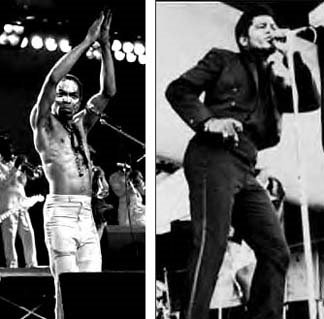
Disciples of Fela’s Afrobeat and of James Brown’s soul have always had mutual admiration. But a debate persists: who stole whose shit? Myths & rumors abound, but the answer is as complex as the perpetual musical cross-pollination between Africa & the Americas. Both influenced each other. It's a universal truth: ‘bad cats recognize other bad cats, and often covet their particular funk’.

In the mid 1960’s Fela was star-struck by the heavy groove and conspicuous success of James Brown and local JB proponent Geraldo Pino (Sierra Leone). Fela said, “his equipment… something else… he came in a big way… one of those big American cars. Flashy new equipment. Lots of bread. He had everything I didn’t have…I had seen the impact this motherfucker had in Lagos… he had everyone in is pocket… I knew I had to get my shit together quick!” (excerpted from Fela, Fela, This Bitch of a Life, by Carlos Moore 1982).

But James Brown’s band also came to hear Fela perform at the Shrine, and attempted to capture some of his “African feel”. Here is are excerpts from interviews with Tony Allen & Bootsy Collins (JB’s bassist) from The Guardian:

"Tony Allen, Fela's drummer and a key architect of Afrobeat, claims that Brown sent his arranger, David Matthews, to check him out. 'He watches the movement of my legs and the movement of my hands, and he starts writing down ... They picked a lot from Fela when they came to Nigeria. It's like both of them sort of influenced each other. Fela got influenced in America, James Brown got the influence in Africa.’

When James Brown toured Nigeria in 1970, bassist William 'Bootsy' Collins recalls, '[Fela] had a club in Lagos, and we came to the club and they were treating us like kings. We were telling them they're the funkiest cats we ever heard in our life. I mean, this is the James Brown band, but we were totally wiped out! That was one trip I wouldn't trade for anything in the world.'"
For the full text of the interview, click here. "The Big Fela"

**
In another interview, Bootsy also stated, "I thought THEY were the greatest, period. Even before I got
into James Brown's band, the James Brown band was number one to me. But once I got there and saw Fela and them, then I had second thoughts about it....when I heard these cats, it was like another dimension... a deeper feel to me...it was like, 'Man, this is IT. We gotta try to be like this!' [laughs]..." (Excerpted from Jaybabcock.com.)

***********

This is an interview with David Matthews (James Brown’s arranger) from the Red Bull Music Academy.

“DAVID MATTHEWS: »It was the most amazing thing I had ever heard. It was the early years of what Fela had called the ’Afrobeat’. And to some degree it incorporated James’ style and rhythms. They had a James Brown rhythm section, plus 8 percussionists, doing the African rhythm thing. And it was – you couldn’t sit down when they were playing. It was just so infectious, it was an amazing experience.«

RBMA: »…You in fact, were impressed with Fela’s arranging.«

DM: »Yes.«

RBMA: »Did you bring any of that back when you were working with Bootsy and the guys?«

DM: »Yes, I did. In fact some Nigerian kid gave me a tape of some of his stuff. And then Fela heard about it and he thought James was trying to steal his shit. And he was angry! But I did try – some of those feels that I heard Fela and his band play in Lagos…I did try to record some of that feeling with Bootsy, and Clyde, and Catfish.«…”

For the full text of the interview, click here.

Friday, April 21, 2006

“Lead Congas” in Afrobeat

By David McDavitt

In Fela’s Afrobeat, 3 or more conga players were counted among the percussionists. Two (or more) of these played “Rhythm Conga”- adopting the role of support drums in tribal ensemble music. Each drummer held down an unchanging tumbao on one full-sized conga drum, helping to weave the hypnotic polyrhythmic foundation on which the melodic instruments floated.

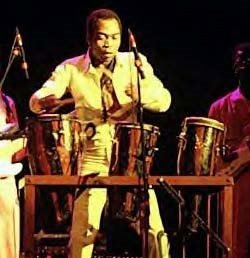
The remaining percussionist played “Lead Congas”- a set of 3 small Yoruba congas, known as Akuba. These drums are part of the “Odigo” ensemble of drums, related to the Gbedu, (often replacing bata in neo-traditional ceremonial usage) . They are tuned major thirds apart, and have a pleasing organic woody sound. In Afrobeat context, these drums are played with sticks, and adopt a lead or master drum role- free to improvise (in the jazz sense), embellish, highlight, add tension, direct/respond to dancers, as well as play highly melodic, & less rigid ostinatos. This player also usually had a set of 3 bells (mounted African gongs or cowbells). Fela often took solos on the Akuba drums in his later career (see “Fela Live”). The beginning of J.J.D. features an intro solo on the Akuba.

Femi Kuti replaced this lead conga set with bongos and timbales.
Check out Lagbadja’s website for more information on Akuba.

The United States of Afrobeat

By David McDavitt
Although Afrobeat is a decidedly Nigerian musical form, it is intrinsically linked with the USA. Afrobeat incorporates drum-kit (an American invention) & other electrified Western instruments as the chosen vehicle of presentation. Also, Fela emulated the band organization & soul stylings of James Brown’s band due to its sheer power, funkiness, and popularity/success. Afrobeat compositions have Western structure (distinct support & solo sections, strict song forms). Afrobeat is harmonically rooted in modes of US jazz, classical, & soul. Perhaps most importantly, America put the protest, politics, & anger in Fela’s music (and really, who isn’t enraged by the US). Fela stated he “discovered” Africa in the USA (i.e. consciousness of protest politics & Black pride/power), studying Malcolm X and the civil rights movement with Sandra Izsadore (an active Black Panther). Fela was inspired to promote pride in African heritage, encourage pan-Africanism, & fight colonialism. And finally, the current renaissance of Afrobeat music is most ubiquitously represented in America. This includes two of the great pioneers of the Afrobeat resurgence (the Daktaris, & spinoff, Antibalas), and over half of the 40 actively performing Afrobeat bands. Ifa bless the good ole United States of Afrobeat!