News, reviews and commentary on afrobeat and related music from Africa, The Caribbean and The Americas
Showing posts with label Congo. Show all posts

Tuesday, July 25, 2006

Konono N°1: Magic Music from the Congo

By David McDavitt
11:30, Friday night. The oppressive, tropical heat permeates the inky darkness hiding the seething mass of humanity packed into the sprawling club. The heavy air is charged with anticipation, as the drenched crowd cranes to see the preparations on the darkened stage, a brief lull between the swells of African music washing over the audience. The opening act, “Chopteeth” has incited the onlookers with a propulsive set of Afrobeat and Highlife, and now the throng are preparing for full-on dance riot.

Suddenly, the dull glow from the stage bursts into a blinding radiance, as the lights are raised and Congolese ensemble “Konono N°1” takes the stage. Large African agogo bells sound a polyrhythmic call. A cycle of warm buzzing amplified thumb-piano tones is joined by others, forming an interweaving line of syncopated melodies, evoking ancient, sacred, organic soukous. This bubbling, rasping ostinato is accompanied by bush Congo drums, and a homemade iron hi-hat & snare drum. Each enchanting composition drones on for a quarter-hour plus, heightening its effect. Songs melt into each other without breaks in between. Sick lamellophone licks dominate the night. The audience rocks intensely to the pulsing sonic waves, a sweaty, bobbing sea of ecstatic, tranced-out zombies hypnotized by the deep Congo vibrations.

Many visitors to Africa can relate to this experience, but satisfyingly, this scene in fact occurred in Washington DC, at the Black Cat (sans a/c), July 21. Konono N°1 is a band from Kinshasa, Democratic Republic of Congo. Formed by musician and truck-driver Mawangu Mingiedi, in the late 1970’s, Konono N°1 play electrified Zombo (or Bazombo) music. The Zombo live along border of Congo & Angola, and have an economy based upon farming & hunting.

Pressured by years of Belgian occupation, Mingiedi, and some fellow émigrés relocated to the city (Kinshasa). Wanting to maintain & propagate his Zombo music & honor the ancestors, he formed Konono N°1. The foundation of the band’s sound is 3 likembé (or “sanza”) thumb pianos [bass, tenor, and solo/treble]. Sanza (with Congo drums) were traditionally employed by the Zombo to honor and invoke the ancestors.
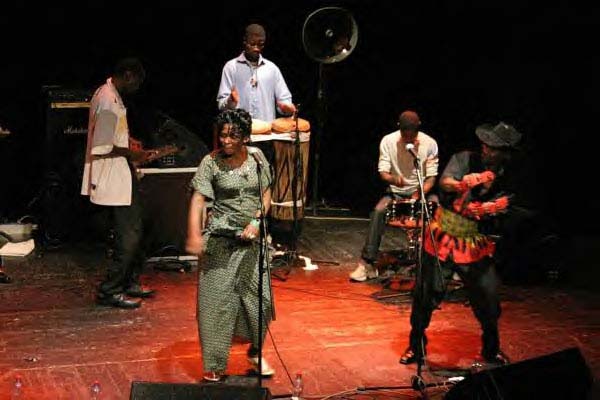

But there was a problem: it was difficult to hear the traditional likembé on the streets of Kinshasa. Mingiedi’s solution created Konono N°1’s signature sound. Deciding to amplify the thumb pianos, but lacking the money to buy imported equipment, Mingiedi built microphones, pick-ups, and amplifiers out of junkyard scrap (Belgian car radios/alternators), powered the system with car batteries (electricity did not reach Kinshasa’s suburbs), and employed large discarded colonial PA siren-cones “lance-voix” (voice-throwers). To this Konono added traditional drums, police whistles, snare drum, scrap metal hi-hat, & chorus vocals.

This system, while effective, added unintended & inexorable distortion to the sound. While this might vex Western ears, such buzz is actually sought in many African musical contexts (for example the spider egg-sack membranes stretched over holes in balaphone resonators, or the bottle-caps affixed to mbira resonators). Embracing this aberration, Mingiedi cultivated a distorted modern mutant breed of Zombo roots music, that has been erroneously compared to myriad punk and electronica experimental artists.

Konono N°1’s compositions are modal explorations rather than keyed chord progressions. Songs have distinctive bass-guitar-like lines played on the bass likembé (played through a bass amp for touring purposes). The tenor & solo likembé may be likened to distorted finger-picked guitar lines (played through modern guitar amps). The 16th note clave-accented hi-hat & snare drum parts suggest the influence of modern soukous music, while the Congo drums (tam tam) and agogo bells play traditional-sounding melodic rhythms floating between subdivisions of 4 and 6. And the music is amplified LOUDLY! All is played with the impeccable discipline and authority of village elders.

Seek Konono N°1, they deserve your attention. Their live show is a multi-sensory wonder to behold.


Discography
• Zaire: Musiques Urbaines a Kinshasa, Ocora 559007 (compil; recorded 1978, released 1987)
• Lubuaku, Terp AS09 (2004)
• Congotronics, Crammed Discs 27 (2005)
• CONGOTRONICS vol. 2 (CD+DVD), Crammed Discs B000E6EJK2 (2006)


LINKS:
- Konono N°1’s homepage- "All About Jazz" article
- Afropop.org review- National Public Viking's blog entry about the concert

Sunday, May 21, 2006

Franco and Mobutu

By Robert Fox

Afropop Worldwide currently has a very interesting article about the history of Congolese music. It’s based on interviews with Dr. Kazadi wa Mukuna, an ethnomusicologist and author who teaches at Kent State University in Kent, Ohio, and Lubangi Muniania, an arts educator, community scholar and president of Tabilulu Productions based in New Jersey.

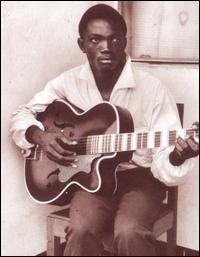
The authors review how the brutal history of the Congo created a modern musical culture that prized “authenticite,” a nationalist sense of black power, set in opposition to 500 years of colonial exploitation and racism. Kazadi wa Mukuna discusses how even corrupt dictators like Mobutu Sese Seko were able to take advantage of the need for “authenticite” in justifying their rule—for example by enlisting Franco, aka Luambo Makiadi, a towering figure in Congolese music. Franco was a powerfully influential singer, guitarist, bandleader, composer and arranger, and Kazadi wa Mukuna explains how Mobutu took advantage of Franco’s fame:
Mobutu was not an idiot. He was a very smart man. He knew that he could use musicians to push forward his mission. Franco was instrumental. And Franco took advantage of this to compose songs about authenticite. Franco wrote about everything. He spoke about every aspect. Authenticite was subject that he was close too. “Belela Authenicite Congres Na Congres” MPR is one of those song in which he truly revealed his belief. He says in Lingala, “In a foreign country, a foreigner asks, “Who am I?” Proudly and in my way I will tell him that I am Zairois. My party is MPR. My chief is Mobutu.” It all comes down to “belonging.” Franco took that traditional concept of belonging and used and summarized it to put it in terms of authenticite as Mobutu defines it saying that “MPR is family and politically organized. If you are born Zairois, you are a member of the MPR.”
The article also addresses how high copper prices in the early 1970s gave Mobutu an opportunity to pose as a legitimate leader by hosting the epic music festival that accompanied the Ali-Foreman “Rumble in the Jungle” fight, which included James Brown, Stevie Wonder, the Fania All-Stars and many other musical heroes.

There are nice summaries of Franco’s musical influence on the Leopardman’s Guide, RetroAfric and All Music Guide. You can purchase Franco’s historic 1956 recordings on the RetroAfric website.

Sunday, May 07, 2006

Kinshasa + Havana = "Kinavana"

By Marc Bruner

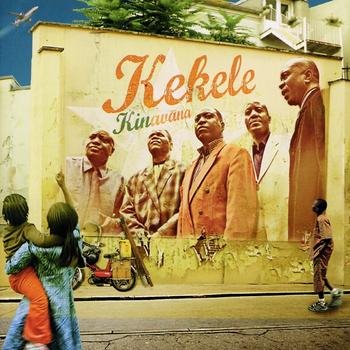
There has long been a strong and intimate connection between Cuban and Congolese music. This is powerfully illustrated by the music of Kekele, a veritable all-star group of veteran Congolese musicians devoted to "rhumba," the Congolese version of Cuban rumba music. Check out their latest release, Kinavana, for a wonderful blend of Cuban and African sensibilities.

Afropop Worldwide aptly explains the longstanding cross-Atlantic connection: "By the closing years of the Belgian Congo, the city of Leopoldville (today’s Kinshasa) was a place where city boys plucked out highlife songs on box guitars, phonographs and radios played the latest mambo and son hits from Cuba, and people from deep in the Congo’s remote, culturally rich interior came to seek opportunity. Pop bands mainly existed to entertain the white elite, and played imitations of foreign music. The Cuban music, with African (including Congolese) rhythmic ideas at its heart, was naturally familiar and attractive to local musicians and listeners. So when musicians in Leopoldville began to make electric pop music for themselves, that music provided an obvious starting point."

Kinavana brings it home full circle. The album is a sweet-sounding, heartfelt tribute to Cuban singer, songwriter and guitarist Guillermo Portables, with an unmistakable African touch. When I played it for my wife, she seemed surprised: "It’s so soothing, but it makes me want to get up and dance." Right on!

Thursday, April 27, 2006

¡Azucar! Fania All-Stars Live in Africa Video

By Robert Fox

I hope you have room to dance in front of your computer: get a load of this blistering streaming video clip of the Fania All-Stars from their historic 1974 concert in Kinshasa, Zaire (Congo), featuring Celia Cruz at the height of her powers, backed by one of the greatest big bands ever put together. Wow--now that's funky!

This footage is from the video "Fania All-Stars Live in Africa," shot in front of 80,000 people at Stadu du Hai in Kinshasa as part of the "Rumble in the Jungle" concert series linked to the Ali-Foreman fight (as depicted in "When We Were Kings"). The Fania Live in Africa video is now available on DVD.

Can I get a witness? This band defines classic salsa with its incredible, heart-stopping funk and masterful musicianship.

The Fania All-Stars of this era included salsero giants Hector Lavoe, Ray Barretto, Cheo Feliciano, Mongo Santamaria, Johnny Pacheco and many other world-class performers, musicians and dancers. Their epic 1975 "Live at Yankee Stadium" is arguably the greatest live salsa album ever recorded, especially considering the time and place. Volume 2 has a special spot on my playlist, and also includes historic live cuts from Roberto Clemente Coliseum in San Juan. Check it out for the sheer energy, gigantic groove and incomparable vibe. ¡Vaya!