By Robert Fox
This is so funky that watching it nearly makes me pass out. A very different twist on a classic tune, from a German television show in 1973. It doesn't get much groovier than this. Gotta love Deniece Williams leading the backing vocals:
Showing posts with label Funk. Show all posts
Showing posts with label Funk. Show all posts
Saturday, February 25, 2012

Tuesday, June 03, 2008
Lost Photos of Sly Stone Surface
 By Robert Fox
The New York Times had an interesting piece this week about Sony BMG Music realizing that they were sitting on a treasure trove of old musician photographs from the 1950s, 60s and 70s. Shot by photographers working for the label, the archive apparently includes never seen images of Miles Davis, Count Basie, Johnny Cash, Bruce Springsteen and many others, including a young Cassius Clay recording his spoken word album "I Am The Greatest." They're now making prints available for sale--and priced to move at prices of up to $1,700 each.
But you can check this one out for free: Sly in all his 1973 glory, the year his album "Fresh" was released. Yes I! Dig the reel-to-reel, the groovy wallpaper, the giant 'fro. Or this group shot of the Family Stone when funk was fresh and the fashions were...um....creative!
 You can see a slideshow of 14 other images from the archive here. In mid-July the Morrison Hotel Gallery will mount an exhibit of the images at 124 Prince Street in New York City. In August, there will be a separate exhibit of Miles Davis images from the archive. Maybe you should check your closets too---who knows what you'll find in there?
Sunday, March 02, 2008
The Tightest Band In History?
By Robert Fox
Very possibly.
Check this out: James Brown live in Paris, 1971, "Ain't It Funky Now." Featuring Phelps "Catfish" Collins on lead guitar, Bootsy Collins on bass, Fred Wesley on trombone, Maceo Parker on sax. This was recorded shortly before most of the band left to help form Funkadelic, when JB became just too much to bear.
Incredible focus and musical unity. This is the Rosetta Stone of Afrobeat, and you can see the source of many of the elements of Fela's stage show here. Never can say enough about James Brown, modern super-hero and freak:
Monday, December 25, 2006
Mr. Dynamite Dead at 73
 By Robert Fox
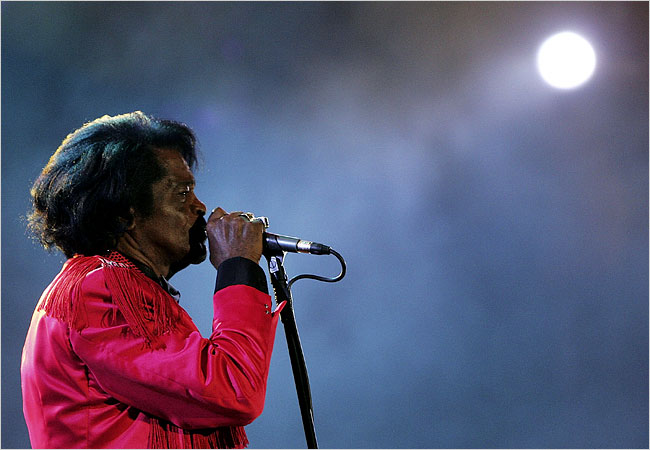
Sad news on Christmas morning: James Brown is dead. It's hard to put into words the impact JB had on 20th Century music. He nearly singlehandedly invented not one but two major musical forms, Soul and Funk, and charted the course for countless artists despite his many quirks and periods of erratic behavior. While it's been some time since The Godfather of Soul was at peak form, his most vital music remains as fresh and innovative as ever. Jon Pareles in today's New York Times concisely summarizes the career and earth-shattering power of James Brown--the first of many eulogies and rememberances that are sure to come:
James Brown, the ‘Godfather of Soul’, Dies at 73Long Live James Brown!
By JON PARELES
The New York Times
James Brown, the singer, songwriter, bandleader and dancer, who indelibly transformed 20th-century music, died today at Emory Crawford Long Hospital in Atlanta, where he been admitted on Saturday for pneumonia, news services said. He was 73 years old and had lived in Beech Island, S.C., near the Georgia border.
His agent, Frank Copsidas, told The Associated Press Mr. Brown died of congestive heart failure.
Over a career that lasted more than 50 years, Mr. Brown called himself "the hardest working man in show business," "Mr. Dynamite," "Soul Brother No. 1," "the Minister of Super Heavy Funk" and "the Godfather of Soul," and he was all of those and more.
Mr. Brown's music was sweaty and complex, disciplined and wild, lusty and socially conscious. Beyond his dozens of hits, Mr. Brown forged an entire musical idiom that is now a foundation of pop worldwide.
"I taught them everything they know, but not everything I know," he wrote in an autobiography.
The funk he introduced in his 1965 hit, "Papa's Got a Brand New Bag," was both deeply rooted in Africa and thoroughly American. It found the percussive side of every instrument and meshed sharply syncopated patterns into kinetic polyrhythms that simply made people dance.
His innovations reverberated through the soul and rhythm-and-blues of the 1970s and the hip-hop of the next three decades. The beat of his instrumental "Funky Drummer" may well be the most widely sampled rhythm in hip-hop.
Mr. Brown's stage moves -- the spins, the quick shuffles, the knee-drops, the splits -- were imitated by performers who tried to match his stamina, from Mick Jagger to Michael Jackson, and were admired by the many more who could not.
And especially during the 1960s, Mr. Brown was a political force; his 1968 song, "Say It Loud -- I'm Black and I'm Proud," changed America's racial vocabulary.
He led a turbulent life, serving prison time as both a teenager and an adult. He was a taskmaster who fined his band members and staff for any errors, and he was an entrepreneur who in 1999 netted $30 million for bonds based on future royalties.
Mr. Brown was married four times, most recently to Tomi Rae Hynie, one of his backup singers. The couple had a child, James Jr.
Living up to his nickname, Mr. Brown performed constantly -- as much as 51 weeks a year in his prime. He was scheduled for a string of performances in the New York area this coming week, including a New Year's Eve show at B.B. King's nightclub in New York.
Mr. Brown's last public appearance was three days ago, when he joined volunteers in Atlanta for a toy giveaway he organized each Christmas.
Sunday, November 12, 2006
The Ohio Players Kick Your Ass
By Robert Fox
Oh Wow!--check out this priceless clip of The Ohio Players doing "Fire" for live television in Germany, circa 1974. Are these guys supermen or what? Unbelievable musicianship and style, hailing from Dayton, Ohio, USA. The German studio TV crowd doesn't seem to know what to think! Note that the fire engine light effect stops after the intro--just keep watching for an unparalleled heavy-duty groove:
Oh Wow!--check out this priceless clip of The Ohio Players doing "Fire" for live television in Germany, circa 1974. Are these guys supermen or what? Unbelievable musicianship and style, hailing from Dayton, Ohio, USA. The German studio TV crowd doesn't seem to know what to think! Note that the fire engine light effect stops after the intro--just keep watching for an unparalleled heavy-duty groove:
Wednesday, November 08, 2006
Where Is Matata?
 By Robert Fox
Matt at the always informative blog Benn Loxo Du Taccu has unearthed some lost classics of African funk: Kenyan funk super-group Matata, who reigned in the early 1970s with afrobeat-inspired, pounding grooves. Matt reports that Matata were awarded "BBC’s Best Band in Africa in 1971 but unfortunately they faded away by the mid-70s," and asks "can someone fill us in?" They appear on the compilation "Africafunk," from Harmless Records. Check out the recording samples on Matt's site, and also the other many insights he offers.
The compilation features under-appreciated tracks from Fela Kuti, Peter King, Manu Dibango and Tony Allen. It also inspired a second volume, Africafunk: Return To The Original Sound of 1970s Funky Africa, also by Harmless Records.
Regular readers of this blog will definitely appreciate Matt's wisdom on the Benn Loxo Du Taccu blog. Definitely check it out if you haven't already.
Monday, November 06, 2006
Rhino Releases Funk Treasure Chest
 By Robert Fox
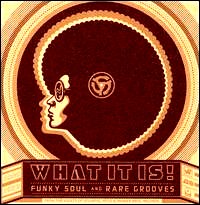
Get your funk face on, quick!--Rhino records has blessed Funkateers the world over with a newly released, epic boxed CD set entitled “What It Is! Funky Soul And Rare Grooves (1967-1977).” Rhino combed through a generation’s worth of dusty tapes and LPs from labels including Warner Bros., Atlantic, Reprise, Atco, and smaller outfits like Cotillion, Curtom, Alston, and Jonie.
And guess what they found? The history and evolution of funk, from the bopping, Stax-inspired grooviness of the early period all the way to the heavy-duty, bone-crushing jams of the mid and late 70s. The set includes 91 newly remastered tracks on four CDs--more than five straight hours of wah-wah pedals, platform shoes, polyester suits and Superfly hood ornaments. Daaaammn!
The songs are arranged chronologically, so you can hear the development of the music year-by-year. Some of the biggest names in American music are represented, most with rare or previously unreleased tracks, including little-known gems from Grant Green, Eddie Harris, Curtis Mayfield, Sly, the Bar-Kays, The Meters, Mongo Santamaria, Little Richard, Earth Wind and Fire, Fred Wesley and many others. There is an entirely re-mixed new version of Aretha Franklin’s “Rock Steady,” (which has recently been appearing on Chopteeth’s live setlist, incidentally).
But connoisseurs of funk will especially appreciate the many singles that have otherwise slipped off the face of the Earth, including finds such as “Mr. Cool” by Rasputin’s Stash, “Wah-Wah Man” by Young-Holt Unlimited, “Won’t Nobody Listen” by Black Haze Express, “Mojo Hannah” by Tami Lynn, “Take It Off, Part 2” by Johnny Tolbert, “Sexy Coffee Pot” by Tony Alvon and the unforgettable “Pig Snoots, Part 1” by Natural Bridge Bunch. Where are these guys today, so we can give them a medal for their Dedication to The Funk?
Predictably, given the scope of this project, the CD set is drawing foaming-at-the-mouth reviews. For example, this bit of poetry from the Amazon.com comments page: “if you’re into funky American music from the 1970s, you’ll cream in your bell bottoms over this one.” Allmusic.com’s review was no less adulatory, although better written:
A righteous undertaking of great magnitude, What It Is! Funky Soul and Rare Grooves trawls through a decade-long stretch of the Warner-distributed archive…and pulls up 91 soul/funk truffles, almost all of which were left for dead shortly after release. While many of these cuts have been repurposed as vital ingredients of hip-hop tracks, which has in turn fostered a voracious collector's market (it would cost a fortune to collect these songs in their original formats of release), the box is a leagues-deep trawl through an otherwise forgotten past... The chicken-scratch guitars, wild Hammond B-3 runs, group chants, and blaring horn punches are served by the dozens, but the box also illustrates an evolution that took place through the '70s…The themed playlists and imaginary compilations hiding within this compact box are innumerable, bound to take the average overthinking funk freak to new levels of nerd-dom…The accompanying booklet could be sold separately, as it contains scads of seldom-seen photos and scholarly track-by-track notes. Rhino also deserves applause for resisting the urge to house these discs in a massive synthetic afro or an oversized wah-wah pedal. You can snugly tuck this thing between your arm and chest and sense its power run through your whole body.You’ll have the opportunity to demonstrate your commitment to The Funk by plunking down $60 for the boxed set, although I’ve been enjoying it through Rhapsody’s music subscription service—it’s presumably available from other subscription services as well, and Amazon offers 30 second samples of all the tunes. This set is a wonderful contribution to the history of music, one that regular readers of the Afrofunk Forum will definitely appreciate.
Monday, September 25, 2006
Stevie Wonder: Superstition Ain't The Way
 By Robert Fox
"When you believe in things
That you don’t understand,
Then you suffer,
Superstition ain’t the way…"
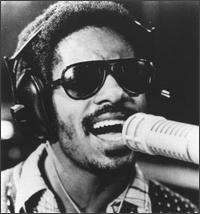
Check out this amazing live TV footage of Stevie Wonder playing “Superstition” on German television (1973?). They didn’t bring the horn section, but the brilliant guitar work and back up singing more than make up for it. What a performance!
The AfroFunk Forum has had visitors from more than 53 different countries in our first six months of existence. Yet for those of us preparing for another “wartime” election in the United States, Stevie Wonder’s words of wisdom still ring especially true as an inspiration more than 30 years later.
I’m increasingly optimistic that at least some of the current superstition and suffering afflicting our country will end (or start ending) with the US election in November. Sadly, in 1973 it must have looked at least as bleak in the US. Yet Stevie continued putting it on the line—I hope you are planning to do the same this year.
This is an historic funk and social justice classic—enjoy!
Thursday, September 21, 2006
The Tightest Rhythm Section in History?
 By Robert Fox
The AfroFunk Music Forum is returning in force after a brief summer break! Stay tuned for regular doses of the latest in music news and links about afrobeat, funk and any other groovy info.
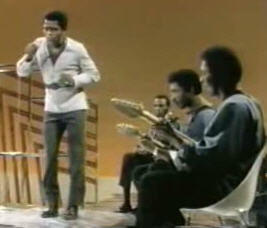
To kick-start things, check out this video clip of JB on mainstream US television delivering Mother Popcorn, circa 1968: holy crap, how can this band be so tight?!?
I especially like how the horn section becomes a collective percussion or rhythm instrument, with their staccato, repeated choruses. Fela frequently used the same technique to dynamic effect.
The percussive, rhythmic horn section is a musical linkage to big band swing era when bands led by Louis Armstrong, Duke Ellington, Benny Goodman, Dizzy Gillespie and so many others built an entirely new music around the (pre-electric) giant horn section, keeping the rhythm going in large dance halls. The horn sections back then were the analog Marshall stacks of their day (more on that later).
While the later bop jazz innovators broke down that collective horn section vibe, it definitely still packed a wallop by the time JB hit the scene, and still does so today—not least of all in the many bands participating in the afrobeat revival movement that is lighting up dance floors worldwide. Viva Horns!
And do check out the blistering sax solo at the end by nobody other than the amazing Maceo Parker---wow!
Tuesday, June 27, 2006
Go Go: The Sound of DC
by David Font-Navarrete
 When I first came to Washington, DC from Miami, the sounds blasting out of cars made me do a double-take every time. The Doppler effect made the music sound like like Konono No. 1, but harder. And slower ... and ... American ... but, from down the street, I swear it sounded like a futuristic African dance party. I heard it here first: Go Go.
From wikipedia.com:
"Go-Go is a subgenre of funk music developed in and around Washington, D.C. in the mid and late 1970s. While its musical classification, influences, and origins are debated, Chuck Brown (b. 1934) is regarded as the fundamental force behind the creation of go-go music. Go-go is defined by continuous, complex, heavy rhythm arrangements focused through two motifs performed on multiple congas, tumbadoras, and rototoms, interspersed with timbale and cowbell parts, driven by heavy-footed drumming and punctuated by crowd call-and-response."
Maybe you're reading this blog from Japan or the Ukraine and you dig Fela. Does the rest of the world really KNOW that DC has its own, home-grown, funky music? Personally, I like anything with three percussionists, but if Go Go music doesn't share a ridiculous amount in common with Afro Beat, you can call me Paco ... It's urban, it's local, it's party music. AfroFunk Forum readers: Go Go IS AfroFunk ...
Here are some Go Go-related links:
An online radio station dedicated to playing Go Go 24-7: http://www.gogoradio.com
The Wikipedia entry on Go Go (quoted above): http://en.wikipedia.org/wiki/Go_go
And a couple of sites with more links to all things Go Go:
http://johnhenry22.tripod.com/gogo.html
http://www.urbanconnect.com/gogo.htm
Saturday, May 20, 2006
Calling The Mothership
 By Robert Fox
Oh yes! Classic video of Parliament Funkadelic live in Houston, 1976. Glen Goins calls down The Mothership. Accept no substitute...
Wednesday, May 17, 2006
Curtis Mayfield Is The Answer
 By Robert Fox
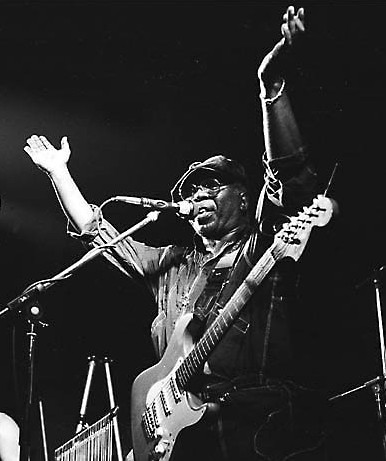
Curtis Mayfield inspired people everywhere with his political vision, personal insight and ground-breaking soul and funk. The worldly music he laid down with The Impressions and on solo albums like “There’s No Place Like America Today,” and “Superfly” live on with enormous influence among musicians, fans and activists. These recordings are among my favorites in any musical genre. Curtis’s “People Get Ready” is an anthem for the ages, and is my personal standard for music to organize a revolution with.
Recently, there was a wonderful radio memoir related to Curtis Mayfield on the National Public Radio show “Studio 360.” It’s by Dave Alvin of the roots-rock group The Blasters. In the moving memoir, Alvin describes the challenges of his early music career, and how seeing Curtis Mayfield perform helped him regain his focus on what's meaningful and on why musicians are so fortunate. He describes how Curtis changed his life---I’m sure he’s not the only one.
Check out this wonderful streaming audio file (4 minutes) of Dave Alvin on the impact of Curtis Mayfield.
The music in the memoir is from the phenomenal Curtis/Live! album, recorded in 1971 at New York’s The Bitter End. All Music Guide calls it “simply one of the greatest concert albums ever cut by a soul artist.” It’s truly amzing, and still precisely on the mark politically.
Monday, April 03, 2006
Miami Funk 1967-74
By Robert Fox
In 2003, the UK's Soul Jazz label released a superb collection or rare and previously "lost" hard funk classics from Miami's fertile music scene of the late 1960s and early 1970s. The album was titled "Miami Sound: Rare Funk & Soul from Miami Florida 1967-1974," and it includes a brilliant set of chunky, sweaty grooves from local Miami artists who never hit the big time but who could obviously Bring It in a serious way.
This was powerful, raw music, recorded low-fi, but with a swinging energy and an all-around strutting attitude influenced by James Brown, Stax Records and the Afro-Cuban grooves drifting over Miami radio. It's a winning combination, and many of these tunes deserve to be classics: "Funkadelic Sound" by Little Beaver; "Cramp Your Style" by All The People; "Do It To Me One More Time," Joey Gilmore; "Fantasy World," James McKnight, etc.
You can check out some song samples from the CD on the Barnes and Noble website.
For 2006, "The Godfather of the Miami Sound," producer Henry Stone, has added two additional volumes of Miami Funk from the same era. They are released under his own label as "Henry Stone Presents Miami Funk Volumes 1 and 2." If anything, these two CDs only increase the temperature further by digging deep into the Miami funk archives.
The new releases feature four-alarm jams such as: "Funky In the Hole" (you know which one) by The Blowflys; "Mashed Potato Popcorn" by Freddie and the Kinfolk; "Groove On" by The Famous Chromes; and "Nasty Dog" by The Mighty Dog Catchers. Mmmmmmm, funky!
Check out some song samples of the new releases and buy CDs on the Henry Stone website, or listen to the songs on Rhapsody and other streaming services if you have access to their networks. Have the fire extinguisher ready, however---this is hot stuff!
Subscribe to:
Posts (Atom)